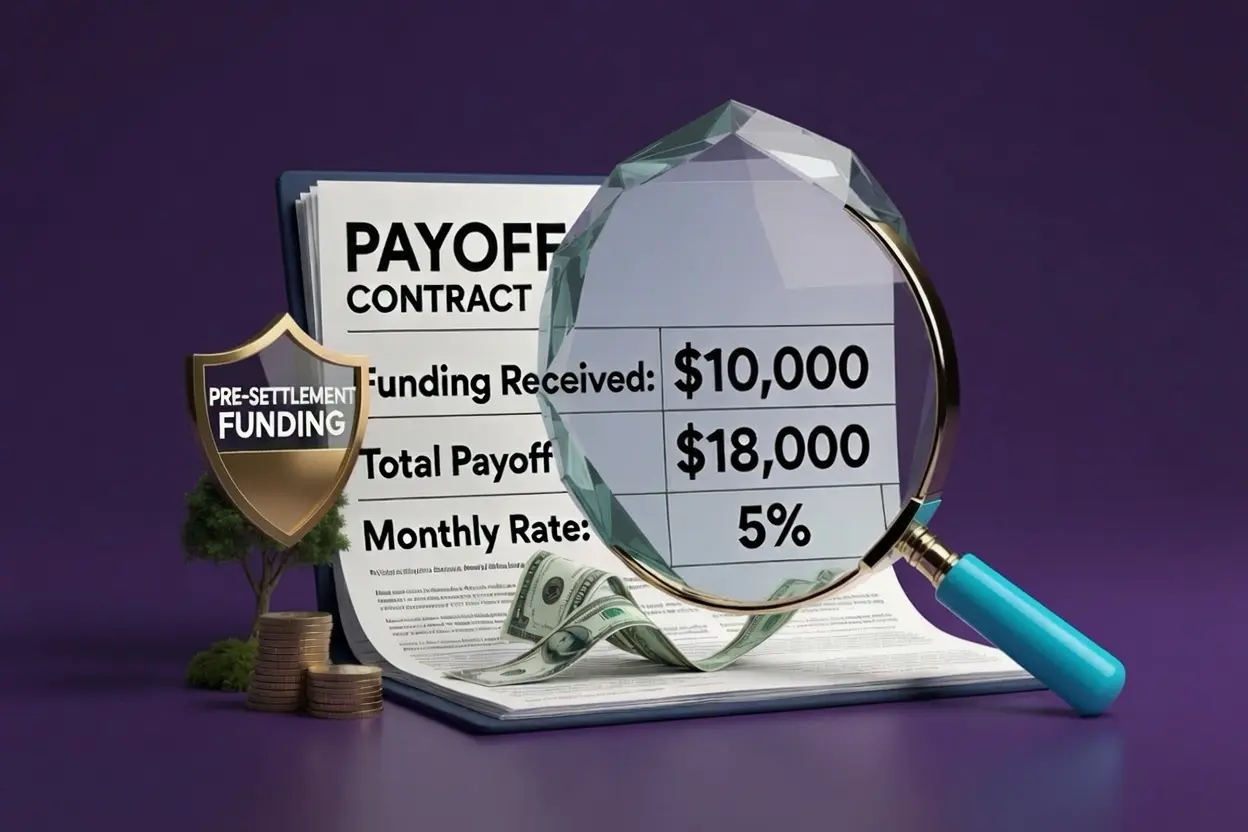
A Letter of Protection (LOP) is a written promise from your attorney — on the attorney’s letterhead — that a specific debt will be paid from your settlement proceeds before any other distribution to you. LOPs let plaintiffs get something they need now (usually medical care, sometimes funding) on the security of the future settlement, without anyone paying anything upfront.
There are two distinct uses for LOPs in personal injury cases, and most online guides only cover the first:
- Medical LOPs — attorney → medical provider, securing ongoing treatment
- Funding LOPs — attorney → funding company, securing a pre-settlement cash advance when the attorney doesn’t want to sign the funding company’s standard contract
This article covers both. If you’re here because your attorney is reluctant to sign a funding contract, the funding LOP section below is the workaround you’re looking for.
Quick navigation
- The short definition
- How a Letter of Protection actually works
- Medical Letters of Protection (the more common use)
- Funding Letters of Protection (the lesser-known alternative)
- What’s actually in a Letter of Protection
- LOP vs. lien vs. funding contract: what’s the difference?
- When LOPs go wrong (and how to avoid it)
- Baker Street Funding accepts Letters of Protection
- Frequently asked questions
The short definition
A Letter of Protection is a written agreement, signed by your attorney, that:
- Acknowledges a debt owed by you to a third party (a medical provider, a funding company, or sometimes another type of creditor)
- Promises payment of that debt from settlement proceeds
- Establishes priority for repayment before settlement money is distributed to you
- Does not personally obligate the attorney — they’re not co-signing the debt; they’re just promising to pay it from the proceeds when they arrive
That structure is what makes LOPs useful. The third party gets a credible promise of payment (good enough to provide services or advance funds), and you get to keep moving forward without paying anything upfront.
How a Letter of Protection actually works
The mechanics are simple. Here’s the lifecycle of a typical LOP:
Step 1. You need a service (medical treatment, cash for living expenses, etc.) but can’t pay for it now.
Step 2. Your attorney sends an LOP, on firm letterhead, to the third party — the medical provider, funding company, or other creditor. The letter spells out exactly what’s being promised: payment of [amount] from settlement proceeds in case [your name], pending in [court].
Step 3. The third party accepts the LOP and provides the service (treatment, cash advance, etc.). You don’t pay anything upfront.
Step 4. Your case settles. The settlement check lands in your attorney’s IOLTA trust account.
Step 5. Before disbursing the remainder to you, your attorney pays the LOP creditor from the settlement — typically in this order: attorney fees, medical liens, LOP creditors, then you.
Step 6. If the case loses or recovers less than expected, the LOP creditor and you (with your attorney) typically negotiate a reduced payment or write-off. Most reputable providers accept reduced settlements rather than chasing the plaintiff for personal liability.
This last point is important: an LOP is not a personal guarantee. You’re not personally liable for the LOP debt the way you’d be on a credit card. The debt is secured by the settlement, not by you. If there’s no settlement, an underlying debt may still exist (like owing the doctor for treatment), but the LOP itself doesn’t expand it.
Medical Letters of Protection (the more common use)
The classic LOP use case: you need medical treatment for your injury, you can’t afford to pay out of pocket, and your health insurance either doesn’t cover it or doesn’t exist.
Your attorney issues an LOP to the medical provider — typically a specialist (orthopedic surgeon, neurologist, pain management physician, physical therapist, MRI center, surgery center) — promising that the bill will be paid from your settlement. The provider treats you under the LOP. You get care now; the bill gets paid later from settlement.
Why providers accept medical LOPs. Personal injury cases settle. Most providers who routinely work on LOPs have data showing high payment rates from settlement, often at full billed rates rather than the discounted rates insurance pays. From the provider’s side, an LOP can be more profitable than insurance billing — they just have to wait longer.
Why this matters to your case. Medical LOPs let you build your medical record while the case is pending. That record is what your attorney uses to prove damages. Treatment gaps weaken cases; continuous documented treatment strengthens them.
Common medical LOPs cover:
- Orthopedic surgery
- Pain management injections
- Physical therapy
- Diagnostic imaging (MRI, CT)
- Chiropractic care
- Specialist consultations
- Sometimes mental health treatment for PTSD/anxiety after the incident
For more on how medical LOPs interact with funding, see medical lien funding →
Funding Letters of Protection (the lesser-known alternative)
This is the part most online guides won’t tell you — and the one most relevant if you’re struggling to get your attorney to sign a pre-settlement funding contract.
Some attorneys, for various reasons, won’t sign the standard funding agreement that pre-settlement funders use. Sometimes it’s about the contract’s specific language. Sometimes it’s about not wanting to formally endorse a third-party transaction. Sometimes it’s just unfamiliarity. Whatever the reason, a Letter of Protection on attorney letterhead can substitute for the funder’s contract with funders who accept them — including Baker Street Funding.
The mechanics are identical to a medical LOP, except:
- The third party is a funding company instead of a medical provider
- The funding company advances you cash instead of providing services
- The LOP promises repayment of that advance plus accrued fees from settlement
- Repayment is non-recourse — if the case loses, you owe nothing
Why attorneys prefer LOPs over funding contracts:
- They drafted it. The LOP is on their letterhead, in their voice. They control the language.
- One page instead of multiple. Standard funding contracts can run 8–15 pages. An LOP is typically one.
- Familiar workflow. Most personal injury firms issue LOPs to medical providers all the time. The format is already in their daily practice.
- No perceived endorsement. Some attorneys are uncomfortable signing what looks like they’re recommending a third party. An LOP acknowledging a lien feels different to them.
Why funders accept LOPs (when they do):
- Same legal protection. An attorney-letterhead LOP creates the same enforceable lien on settlement proceeds that a contract acknowledgment does.
- Lower friction. No back-and-forth on contract modifications.
- It closes the deal. Plaintiffs who wouldn’t otherwise get funded receive what they need.
Not every funder accepts LOPs. Many large funders require their standard contract and won’t deviate. That’s where the strategic choice of funder matters. Baker Street Funding accepts LOPs as an alternative to contract signature — see more on this below.
What’s actually in a Letter of Protection
Every LOP, whether medical or funding, contains roughly the same components:
- Attorney letterhead — establishes that this is a formal communication from a law firm, not an informal note
- Identification of the plaintiff — your full legal name and contact information
- Identification of the case — court, case number, type of claim, defendant(s)
- Identification of the creditor — name, contact info, and address of the recipient
- The promise — exact dollar amount being protected, or formula for calculating it (e.g., “the medical bill, plus interest at X%, as of the date of settlement”)
- Order of payment — typically: attorney fees, court costs and case expenses, medical liens, LOP debt, plaintiff
- Conditions — including statements that the LOP is contingent on settlement, the attorney’s role is to disburse from proceeds, and the LOP doesn’t create personal liability for the attorney
- Signature — attorney’s wet or electronic signature, dated, with bar number where required
If you ever see an LOP draft that doesn’t include these components, ask your attorney to confirm it’s complete before relying on it.
LOP vs. lien vs. funding contract: what’s the difference?
These terms get used interchangeably, but they’re distinct:
| Document | Created by | What it does |
|---|---|---|
| Letter of Protection | Attorney | Attorney promises to pay a third party from settlement |
| Lien | The creditor (medical provider, funder, government) | Legal claim against settlement proceeds, asserting priority |
| Lien acknowledgment | Attorney | Attorney confirms the lien exists and will be honored |
| Funding contract | Funding company | Defines the funding amount, rate, terms, and lien |
In a standard funding transaction, the funding company sends a contract that includes the lien language. Your attorney signs the lien acknowledgment portion. In a funding LOP transaction, the attorney’s letter substitutes for the lien acknowledgment. The lien itself still exists, just established differently.
The result is the same: when settlement arrives, the funder is paid before you receive the remainder.
When LOPs go wrong (and how to avoid it)
LOPs aren’t risk-free. Here are the main failure modes and how to avoid them:
1. The plaintiff fires the attorney mid-case. The LOP follows the case, not the attorney, but documentation needs to follow correctly. If you change attorneys, immediately notify every LOP creditor in writing so they can re-paper the LOP with your new lawyer.
2. The case loses or recovers less than expected. With medical LOPs, providers often write off some or all of the balance because they can’t collect from a plaintiff personally. With funding LOPs, reputable funders absorb the loss under the non-recourse structure. Predatory funders sometimes try to collect personally — which is why your attorney should review any LOP from a funder before issuing it.
3. Multiple LOPs add up beyond settlement value. A plaintiff with significant medical treatment can accumulate $50K+ in medical LOPs. If they also take a funding LOP, the combined obligations can consume the settlement. Your attorney should be doing this math throughout the case.
4. The settlement check is delayed. LOPs assume settlement will arrive. If the case settles but disbursement is delayed (lien negotiations, structured settlement setup, court approval), the LOP creditors wait — but they may push for status updates. This is normal.
5. The attorney doesn’t actually pay from settlement. Rare, but happens. The most common cause is attorney misconduct (IOLTA mismanagement, fee disputes). LOP creditors can sue the attorney directly in these cases.
Baker Street Funding accepts Letters of Protection
For plaintiffs whose attorneys won’t sign our standard funding agreement, we accept Letters of Protection as an alternative. The mechanics are:
- Your attorney issues an LOP on firm letterhead, promising repayment of the advance and accrued fees from settlement proceeds
- The LOP includes our standard terms — 2.95% per month non-compounding, with either a 2 or 3-year fee cap, non-recourse repayment, lien priority — translated into your attorney’s letterhead format
- We disburse funds to you as we would under a standard contract
- Repayment happens from settlement in the standard order, paid by your attorney from the trust account
We work with your attorney to draft LOP language they’re comfortable with, including reasonable modifications where requested. If your attorney has refused our contract but would be willing to issue an LOP, have them call us at (888) 711-3599 and we’ll walk through the language together. Most of these conversations resolve in a 15-minute call.
Frequently asked questions
What’s the difference between a Letter of Protection and a lien?
A lien is a legal claim against settlement proceeds. A Letter of Protection is the attorney’s promise to honor that claim from settlement. The lien is the legal right; the LOP is the operational mechanism for ensuring it gets paid.
Can my attorney issue an LOP without my consent?
No. An LOP is issued on your behalf and affects how your settlement is distributed. Your attorney should not issue one without your knowledge and approval, and most LOPs require your signature acknowledging that you understand the obligation.
Are Letters of Protection enforceable in court?
Yes. Courts have repeatedly enforced LOPs as binding contracts between the attorney’s firm and the creditor. The plaintiff is not typically a party to the LOP itself — it’s between the attorney’s firm and the creditor — but the plaintiff’s settlement is affected by it.
Can a funding company refuse to accept a Letter of Protection?
Yes. Many funders only accept their standard contract. Some accept LOPs but only in specific circumstances. If you need a funder that accepts LOPs, ask before applying — it’s much harder to negotiate after the application is submitted.
Will an LOP show up on my credit report?
No. LOPs are not reported to credit bureaus. They’re agreements between your attorney and the third-party creditor, not consumer loans in your name.
What happens to an LOP if I lose my case?
For medical LOPs, the underlying medical debt may still exist (you owed the doctor for treatment), but most providers write off some or all of the balance. For non-recourse funding LOPs, the funder absorbs the loss and you owe nothing.
Can I get an LOP for non-medical expenses like rent or car payments?
Not directly. LOPs typically only cover services rendered (medical care) or money advanced (funding). Your attorney can’t issue an LOP to your landlord for rent, but they can help you arrange a funding LOP that covers rent indirectly.
Does Baker Street Funding accept LOPs from any attorney?
We accept LOPs from licensed attorneys representing you on contingency, where the LOP language meets our standard requirements (non-recourse, lien priority, defined repayment terms). If your attorney is willing to issue an LOP, we’ll work with them on the language.
Have an attorney who won’t sign a contract but might issue an LOP?
Call (888) 711-3599 and ask for a funding specialist. We’ll talk to your attorney directly to discuss LOP language, walk them through the process, and confirm we can fund through an LOP arrangement. Most attorneys who refuse contracts find LOPs much easier to engage with.
You can also apply online → and note in the application that you’d like to pursue an LOP-based arrangement. We’ll route you to a specialist who handles these.
This article is for informational purposes only and is not legal advice. Letter of Protection enforceability and form vary by state. Consult your attorney for specific guidance on LOPs in your case.