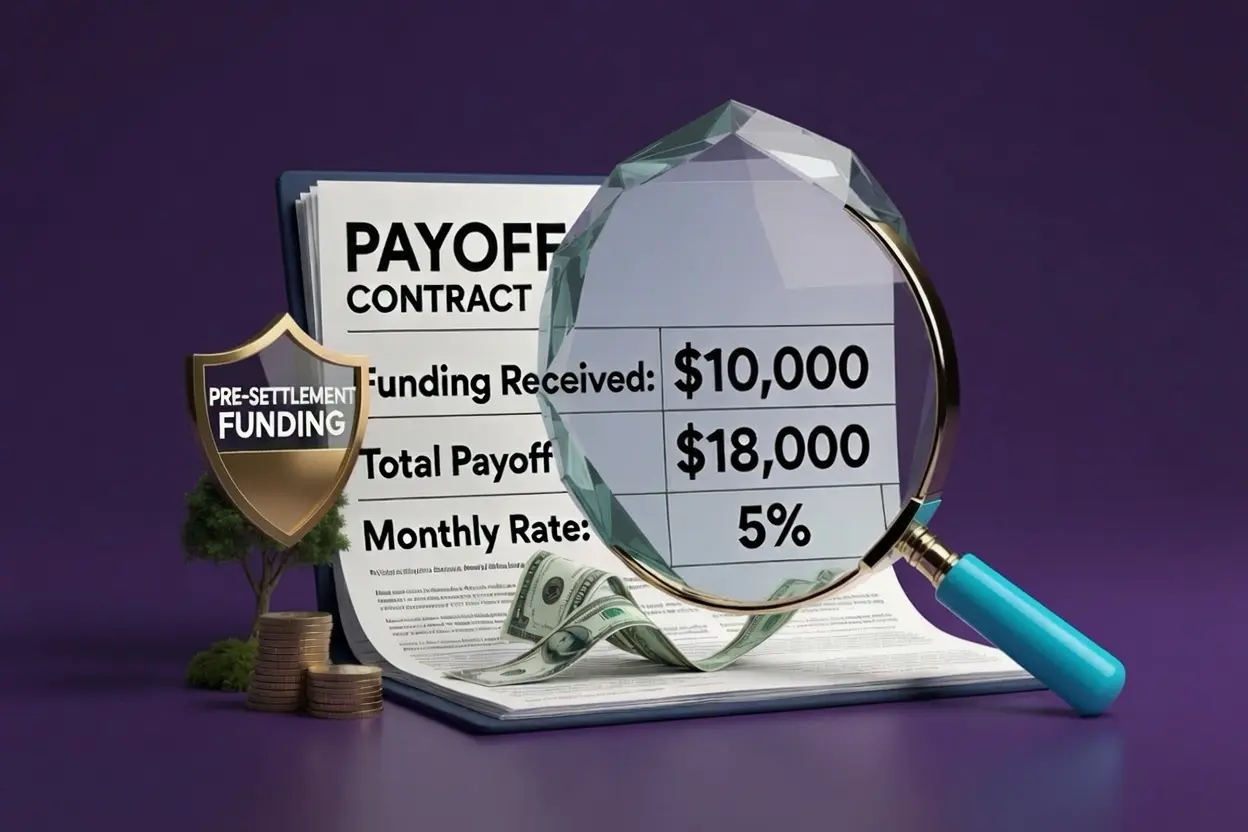
A hidden fee in pre-settlement funding is any charge that does not appear, in plain dollars, in your funding contract’s payoff schedule. Here is the part most plaintiffs don’t know: a fee that isn’t written into your contract usually can’t be collected at all. In states that regulate consumer legal funding, the disclosures in your contract are material terms — the company is limited to what the contract says. Everywhere else, charging beyond the contract is a breach of it.
So “hidden fees” in this industry rarely means a surprise invoice. It means charges that are technically disclosed but easy to miss: a percentage deducted before your money arrives, a monthly “servicing” line, or an interest structure that quietly doubles your payoff. This guide shows you exactly where to look.
This article is general information, not legal advice. Review any funding contract with your attorney.
What counts as a hidden fee in pre-settlement funding?
There are two kinds, and the difference matters.
Charges that were never disclosed
These are the true hidden fees — and they are largely a myth in practice, because the structure of legal funding makes them nearly impossible to collect. You pay nothing while your case is pending. The only payment ever made happens after your case resolves, when your attorney pays the funder from settlement proceeds against the written payoff fixed in your contract. A licensed attorney reconciles that payoff letter against the signed agreement. A charge that isn’t in the contract has no mechanism to get paid.
Charges that were disclosed but buried
This is where plaintiffs actually lose money. The fee is in the contract — on page six, as a percentage, inside a defined term. It’s legal. It’s also the reason two funding offers with the same advertised rate can differ by thousands of dollars at payoff.
The 7 fees to look for before you sign
1. Upfront fees — money out of pocket before you’re funded.
This is the brightest red line in the industry. Legitimate non-recourse funders never ask you to pay anything before funding, because they’re repaid from your recovery, not from you. An “application fee” due upfront is the signature of a predatory lender wearing a legal-funding costume. Where real funders charge an application or processing fee at all, it’s written in the contract and paid at resolution, out of the recovery, alongside everything else.
Watch for a more dangerous version of this: operations that pose as legal funders but are really illegal lenders. The warning signs cluster together — a cash fee demanded upfront, a rate quoted by the week, no written contract, no attorney involved, and repayment you owe whether you win or lose.
That last point is the giveaway. Real pre-settlement funding is non-recourse: if you don’t win, you owe nothing. Anyone who expects to be paid back regardless of your outcome is making you a loan, not funding your case — often at rates that are illegal in your state. If an offer looks like this, walk away and talk to your attorney. We cover how to spot these operations in Predatory Lawsuit Money Lending: What to Watch For.
2. Origination and broker fees.
In legal funding these are usually the same thing: a fixed, one-time charge for handling your case from start to finish, written into the contract and paid at resolution by your attorney from the recovery. Verify two things.
First, that you receive the full funded amount — in a legitimate contract, a $10,000 approval puts $10,000 in your account, and the fee appears in the payoff schedule, not as a deduction from your advance.
Second, whether interest accrues on the fee. A disclosed, fixed origination fee is not automatically a bad deal: a placed case sometimes carries a lower simple rate than a direct application would, and the only number that matters is the total payoff at your likely settlement date.
3. Underwriting or case review fees.
Some funders charge these instead of an application fee. The same test applies: in the contract, fixed, and paid at resolution. If it’s vague, recurring, or due upfront, walk away.
4. Case management or servicing fees.
A recurring monthly administrative charge layered on top of the rate. Over a two-year case, a $35 monthly servicing fee adds $840 to your payoff without ever touching the advertised rate.
5. Document preparation fees.
Small, legal when disclosed, and easy to stack across multiple fundings. Nevada regulates these so tightly that its rules cap consumers at one document preparation fee per legal claim, no matter how many funding contracts they take (NAC 604C). If a state had to write that rule, you can guess what some funders were doing. One non-fee that often gets blamed on funders: wire charges. Those are typically your own bank’s fee for receiving the transfer, deducted by the bank — not a funder charge, and not large.
6. Undisclosed intermediaries.
A disclosed broker fee is fine — see #2. The problem is a middleman you didn’t know existed, compensated through your terms without appearing anywhere in your contract. Ask any company directly: is anyone else paid on my contract, and where is that written down?
7. Compounding interest — the most expensive “fee” that isn’t called a fee.
A 3% monthly rate sounds identical whether it’s simple or compounding. It isn’t. On a $10,000 advance, simple interest at 3% per month accrues a flat $300 per month — $7,200 over two years. The same rate compounding monthly accrues roughly $10,300 over two years, because each month’s interest is charged on the previous interest. Same advertised number, more than $3,000 of difference, all of it sitting in one word in the contract.
Compounding isn’t automatically predatory — some funders price genuinely high-risk cases this way and say so plainly in the contract. The red flag is the gap between the advertising and the paper: “simple interest only” on the website, a compounding clause on page six.
A note on “flat fee” and “no interest” contracts
Not every funder uses a monthly rate. Some use a tiered flat fee — the payoff jumps in fixed steps tied to the calendar instead of accruing monthly, which is how a contract can be advertised as “no interest” and still cost more than a simple-rate offer. The trap isn’t a hidden charge; it’s the step-up date. Settling shortly after one can raise your payoff by thousands overnight, and each additional advance typically starts its own new schedule on top of the first.
Because this is a pricing-structure question rather than a hidden-fee question, we cover it in full — with worked examples — in Does “No Interest” Lawsuit Funding Really Cost Less?. The short version for this guide: a flat fee is disclosed, so it isn’t hidden — but “no interest” tells you nothing about the total payoff. That’s the only number that matters.
Why a fee that isn’t in your contract usually can’t be collected
In every state, a funder that collects more than the contract states has breached the contract. In states with consumer litigation funding laws, the protection goes further: the disclosures in your contract are the deal.
Nevada is the clearest example. Under NRS 604C.350, a funding contract must contain clear, conspicuous and accurate details of how every charge accrues, plus a stated maximum amount you can be obligated to pay. Under NRS 604C.360, required disclosures constitute material terms of the contract. There is no lawful path to a charge that lives outside those pages.
New York joined the regulated states in December 2025. Its Consumer Litigation Funding Act requires an itemization of all charges in the contract, caps the funder’s total recovery, and gives consumers a 10-day right to cancel, with the law taking effect in mid-2026 (Insurance Journal; bill text). A growing list of states — including Indiana, Oklahoma, Vermont, and Maine — imposes similar itemization requirements, and pending bills in several others would require contracts to confirm that no charges beyond those listed can ever be required.
The pattern across all of these laws is the same: the contract is the ceiling.
Does this mean it never happens? No. A small number of operators do try to collect more than the contract allows — a payoff letter that quietly exceeds the agreed schedule, a charge that was never disclosed. It is rare, and it is also the situation you are best protected against, because of who is standing between you and the money.
Your attorney receives the payoff letter and reconciles it against your signed contract before a dollar is disbursed. If the numbers don’t match, the overage isn’t owed, and your attorney disputes it on your behalf. Keep your signed agreement, and if a payoff figure ever looks higher than your contract’s schedule, ask your attorney to compare the two line by line before anything is paid.
The one moment a hidden fee could ever appear
Here is the structural reality that protects you. In non-recourse funding, no payment of any kind occurs while your case is active — and none occurs after settlement while the recovery is still pending. The single moment money changes hands is at disbursement, when the defense has paid and your attorney pays the funder from proceeds.
At that moment, your attorney holds two documents: the payoff letter and your signed contract. If they don’t match, your attorney — a licensed professional with a duty to you — is the person doing the comparing. That is why undisclosed charges are so rare in this industry, and why your real attention belongs on the disclosed-but-buried charges in the section above, before you sign.
How to read a funding contract in five minutes
Skip the boilerplate on the first pass and find five things:
- The payoff schedule. A table showing what you’d owe, in dollars, at 6, 12, 18, 24, and 36 months. If the contract shows only percentages, ask for the table. Regulated states require it; good funders provide it everywhere.
- The word “simple” or “compounding.” It will be there. Find it.
- The cap. When does interest stop accruing? A 2- or 3-year cap means a long case can’t grow your payoff forever. No cap is a major warning sign.
- One-time charges. Origination, document preparation, delivery. Add them up and confirm the rate isn’t applied on top of them.
- A “no other charges” confirmation. The strongest contracts say outright that you can owe nothing beyond what’s itemized.
If anything is unclear, your attorney reviews the agreement before you sign. That review isn’t a formality — it’s your single best protection.
You might like: What Is Pre-Settlement Funding Underwriting?
Six questions to ask any funding company
- Is your rate simple or compounding?
- Can I see my payoff schedule in dollars before I sign?
- When does interest stop accruing?
- Are any one-time charges deducted from my advance?
- Does anyone — a broker or referrer — get paid on my contract?
- If I take additional funding later, does the fee schedule restart — and can I see one combined payoff number for everything?
A transparent funder answers all six in one phone call. Hesitation on any of them tells you what you need to know.
How Baker Street Funding handles fees
We built our pricing to survive exactly this kind of scrutiny. Rates start at 2.95% per month with simple, non-compounding interest on most cases, capped at two or three years, so a slow docket can’t inflate your payoff indefinitely. You see your rate, cap, and payoff estimate in writing before you sign, your attorney reviews every term, and there are no out-of-pocket fees to apply and no charges beyond what’s itemized in your contract. It’s how we’ve funded thousands of plaintiffs without surprises at disbursement.
Questions about a contract — ours or anyone’s? Call (888) 711-3599 and a dedicated funding specialist will walk through the payoff math with you, line by line. Or read How Long Does It Take to Get a Lawsuit Loan?
FAQ
Do lawsuit loans have hidden fees?
Truly undisclosed fees are rare because the structure prevents them: your attorney pays the funder at settlement against a written payoff fixed in the contract. The real risk is disclosed-but-buried charges — origination percentages, servicing fees, and compounding interest. All of them are visible in the contract if you know where to look.
Can a funding company charge more than what’s in the contract?
Collecting beyond the contract is a breach of contract in every state. In regulated states such as Nevada, contract disclosures are material terms and the contract must state the maximum you can owe, which leaves no lawful room for additional charges. A small number of operators try anyway, which is why your attorney reconciles the payoff letter against your signed contract before any money is disbursed — an overage that isn’t in the contract isn’t owed.
How do I tell a real funder from an illegal lender?
Real pre-settlement funding is non-recourse: you owe nothing if you don’t win, there’s a written contract, your attorney is involved, and nothing is paid upfront. Illegal lenders do the opposite — they demand a cash fee upfront, quote rates by the week, skip the contract, and expect repayment whether you win or lose. If repayment is owed regardless of your outcome, it’s a loan, not funding, often at an unlawful rate. Walk away and talk to your attorney.
Is an origination fee a hidden fee?
Not legally, if it’s disclosed. In effect, it can function like one when it’s presented only as a percentage. Always convert it to dollars and confirm whether interest accrues on the full approval or the amount you actually receive.
Who pays the funding company when my case settles?
Your attorney pays the funder directly from settlement proceeds, against the payoff schedule in your contract, before disbursing your share. You never make payments yourself, and nothing is paid while the case is pending.
What is a flat-fee or tiered lawsuit funding contract?
A contract where the payoff jumps in fixed steps tied to the calendar instead of accruing monthly. “No interest” can be technically true, but settling shortly after a step-up date can raise the payoff sharply, and each additional advance usually starts its own schedule. Because this is a pricing-structure question, we cover it fully in our guide on whether “no interest” funding really costs less — the takeaway is to compare the total payoff, not the label.
What’s the difference between simple and compounding interest on a lawsuit loan?
Simple interest accrues only on the funded amount; compounding interest accrues on the funded amount plus prior interest. At the same advertised monthly rate, compounding can cost thousands more over a multi-year case. The contract will state which one applies — it’s the single most expensive word in the document.