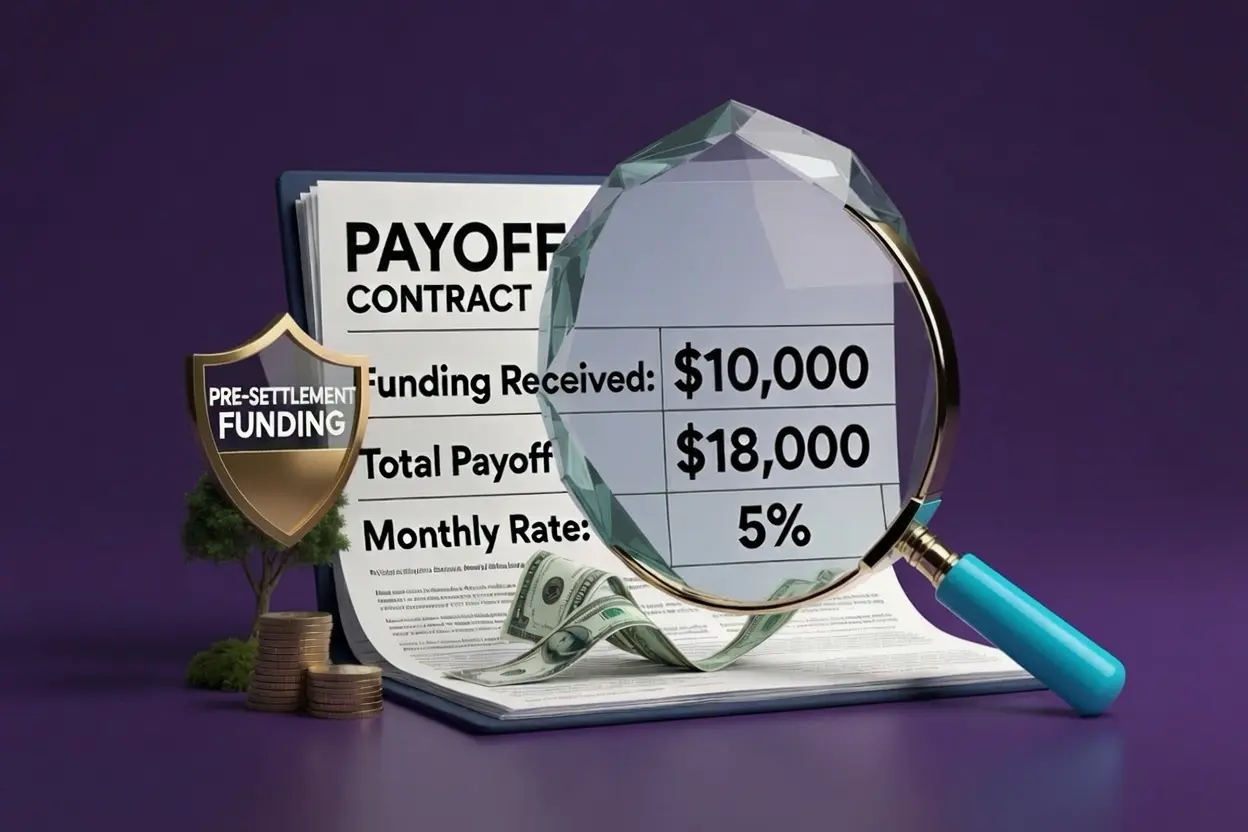
Quick answer: Pre-settlement funding underwriting is the evaluation process a legal funding company uses to decide whether a plaintiff qualifies for a non-recourse cash advance against a pending lawsuit. Underwriters review liability, damages, insurance coverage, attorney involvement, and expected settlement value — never credit or income — to determine eligibility and funding amount.
If you’re an injured plaintiff waiting on a personal injury, wrongful imprisonment, or civil rights settlement, you already know how brutal the wait can be. Personal injury cases take an average of 11.4 months to resolve, and many serious-injury or contested-liability cases stretch well past two years. Meanwhile, rent, medical bills, and lost wages don’t pause.
A pre-settlement cash advance — sometimes called a lawsuit loan, though it isn’t a loan in the traditional sense — bridges that gap. But before any money moves, your case goes through underwriting. This is where a funding company decides whether the lawsuit is strong enough to back, how much it can advance, and on what terms.
Below is exactly what happens during that process, written by the team that does it every day.
What Pre-Settlement Funding Underwriting Actually Is
Underwriting in pre-settlement funding is the disciplined risk assessment a legal funding company performs before advancing money against a pending lawsuit. Because the funding is non-recourse — meaning the plaintiff owes nothing if the case loses — the funder absorbs the entire loss on a failed case. That makes the underwriting decision the single most important step in the process.
Underwriters in this industry typically have backgrounds blending personal injury litigation experience and consumer finance. They read complaints, demand letters, medical records, and police reports the way an experienced plaintiff’s attorney would, then translate that into a probability-weighted estimate of recovery.
In short: a pre-settlement underwriter is not checking you. They’re evaluating your case.
Why Underwriting Matters to You as a Plaintiff
Good underwriting protects you, not just the funding company. Here’s how:
- You won’t be overfunded. Reputable funders cap advances at roughly 10% of the projected net settlement. This keeps you from owing back so much that the case stops being worth pursuing.
- You won’t be locked into a bad deal. A transparent underwriter tells you the payoff schedule in writing, including what you’d owe at 6, 12, 18, and 24 months — before you sign.
- The non-recourse promise is real. If the case is denied at trial or dismissed, you keep the advance with zero repayment obligation.
Why It Matters to the Funder
For the funding company, every approval is an unsecured bet on a future event. Industry data shows roughly 95% of personal injury cases settle before trial, but the 5% that don’t can result in total loss of principal. Underwriting is how a responsible legal finance company stays solvent enough to keep funding plaintiffs at all.
The Pre-Settlement Funding Underwriting Process, Step by Step
At Baker Street Funding, the process from first call to wired funds typically runs 24–48 hours once your attorney provides the required case documents. Here’s what happens in that window.
Step 1: Application
You apply online or by phone — at Baker Street, that’s (888) 711-3599. The intake covers basic case information: type of lawsuit, jurisdiction, attorney’s name and firm, accident or incident date, and how much you’re requesting.
No credit pull. No income verification. No employment check.
Step 2: Attorney Outreach and Document Request
The funding specialist contacts your lawyer’s office and requests the case file. The exact documents vary by case type, but typically include:
- The complaint or demand letter
- Police report or incident report
- Medical records and bills to date
- Insurance policy information (defendant’s coverage limits)
- Any prior settlement offers
- Lien information (medical, child support, tax, bankruptcy)
This is the step that most often slows applications down. Industry underwriters consistently report that the single biggest cause of delay is an unresponsive law firm, not a weak case.
Step 3: Case Risk Assessment
A licensed underwriter reads the file and works through the evaluation criteria below. Strong cases with clear liability and well-documented damages are usually decisioned within hours of receiving complete documents.
Step 4: Offer and Contract
If approved, you receive a written funding offer detailing:
- The advance amount
- The non-compounding monthly funding fee (Baker Street’s rates start at 2.95% per month, capped at 3 years, meaning interest stops accruing after 36 months)
- The full payoff schedule
- Attorney acknowledgement requirements
You and your attorney review the contract. Once signed, funds are typically wired or deposited within a few hours.
What Pre-Settlement Underwriters Look At — The 10 Factors That Decide Your Case
This is the core of the underwriting decision. Every reputable funder weighs roughly these same factors, though the emphasis shifts by case type.
1. Liability and Fault
The clearer the defendant’s fault, the stronger the case. A rear-end collision with a police report identifying the at-fault driver underwrites cleanly. A disputed slip-and-fall with no witnesses and no surveillance footage does not.
Underwriters also look at state fault rules. Pure contributory negligence states (Alabama, Maryland, North Carolina, Virginia, and D.C.) can bar recovery entirely if the plaintiff is even 1% at fault — a major risk factor. Comparative negligence states reduce damages by the plaintiff’s share of fault but still allow recovery.
2. Insurance Coverage and the Defendant’s Ability to Pay
A million-dollar verdict against a defendant with a $25,000 policy limit and no personal assets is, financially, a $25,000 case. Underwriters need to know the defendant’s policy limits — and whether there are additional layers like umbrella coverage, employer liability, or a solvent corporate defendant.
Low or no insurance coverage is one of the most common reasons for funding denial.
3. Strength of the Evidence
Underwriters read the actual evidence: medical records, diagnostic imaging, accident reconstruction reports, witness statements, expert opinions, photographs, surveillance video, and any contemporaneous documentation. The more the file objectively supports the plaintiff’s version of events, the stronger the case underwrites.
4. Injury Severity and Documented Damages
Serious, well-documented injuries — surgeries, fractures, traumatic brain injury, permanent impairment — generally drive larger settlements because they trigger higher economic damages (medical bills, lost wages) and higher non-economic damages (pain and suffering, loss of enjoyment of life). Soft-tissue injuries with minimal treatment usually settle for less.
Gaps in medical treatment are a red flag. A defense attorney will use a 6-month treatment gap to argue the injury wasn’t serious or wasn’t related to the accident.
5. Priority Liens Against the Settlement
Liens get paid first, out of the gross settlement, before the plaintiff or the funder sees a dime. Underwriters carefully account for:
- Medical liens (hospital, doctor, Letter of Protection providers)
- Health insurance subrogation claims (ERISA, Medicare, Medicaid)
- Child or spousal support arrears
- Tax liens (federal and state)
- Open bankruptcy proceedings
- Prior pre-settlement funding from another company
Heavy lien stacks shrink the net recovery — and the advance amount the underwriter can responsibly approve.
6. The Plaintiff’s Background
A plaintiff’s personal history doesn’t disqualify them from compensation, but it can affect case value. Underwriters consider prior similar injuries (which the defense will argue caused the current symptoms), a history of frequent litigation, or criminal history that could affect jury perception. None of these are automatic denials at Baker Street — but they factor into the risk model.
7. Time to Resolution
Money has a time value. A $100,000 case that settles in 8 months is worth more, today, than the same case settling in 36 months — because the funder’s capital is tied up longer. Underwriters favor cases moving briskly through the pipeline, and cases with active settlement discussions are some of the strongest underwriting profiles in the industry.
8. Litigation Stage
Different stages carry different risk:
- Pre-suit / demand stage: Higher uncertainty; settlement value still being established.
- Discovery / depositions: Risk drops as evidence is locked in.
- Mediation or settlement negotiations: Often the strongest underwriting profile.
- Trial-pending: Outcome binary; higher risk.
- Post-verdict / on appeal: Highly case-specific. Funders generally treat appeals as elevated risk because outcomes are unpredictable.
9. Attorney Reputation and Cooperation
A plaintiff’s attorney is the single biggest external factor in case outcome. Underwriters look at firm size, trial experience, the lawyer’s track record with similar cases, and — practically — whether the firm returns calls and sends documents promptly. A well-respected personal injury firm meaningfully improves the underwriting profile.
10. Jurisdiction and Venue
Some jurisdictions are known as plaintiff-friendly; others tend to produce defense verdicts and conservative damages. Underwriters factor in local jury tendencies, judges’ track records, and damage caps where they exist (e.g., medical malpractice non-economic caps in many states).
Pre-Settlement Funding Underwriting vs. Traditional Loan Underwriting
This is one of the most common points of confusion for first-time applicants. Pre-settlement underwriting looks nothing like a bank loan.
| Factor | Pre-Settlement Funding | Personal Loan | Mortgage | Credit Card |
|---|---|---|---|---|
| Credit check | No | Yes | Yes | Yes |
| Income verification | No | Yes | Yes | Yes |
| Collateral | Future settlement | Sometimes | Property | None (revolving) |
| Repayment if you lose | None — non-recourse | Required regardless | Required regardless | Required regardless |
| Monthly payments | None | Yes | Yes | Yes |
| Primary evaluation | Strength of lawsuit | Borrower’s finances | Borrower’s finances + property | Borrower’s finances |
| Approval timeline | 24–48 hours | Days to weeks | Weeks to months | Minutes to days |
The key distinction: pre-settlement funding underwriting evaluates the case, not the plaintiff’s personal finances. Repayment comes from the settlement, paid by your attorney directly out of trust at the end of the case. If there’s no settlement, there’s no repayment.
Which Case Types Get Approved — and Which Don’t
Underwriting outcomes vary dramatically by case type. Here’s where most reputable funders, including Baker Street, land.
Cases Underwriters Typically Approve
- Auto accidents (motor vehicle, motorcycle, truck, rideshare, side impacts) — the bread and butter of pre-settlement funding. Clear liability, established insurance coverage, and predictable damages.
- Premises liability / slip and fall — approvable when liability is documented (incident report, photos, witnesses).
- Work-related accidents regularly funded, especially especially catastrophic work accidents like construction accidents, oilfield, logging/timber, commercial fishing with third party claims, where damages and liability are clear.
- Catastrophic personal injury — severe traumatic brain injury, spinal cord injury, severe burns, amputation, paralysis, orthopedic injuries, and other permanent or life-altering injuries. Clear, well-documented damages and strong settlement value.
- Wrongful death — strong cases where liability and damages are well-established.
- Medical malpractice — funded when supported by an expert affidavit and clear deviation from the standard of care. Higher risk profile, so underwriting is rigorous.
- Nursing home negligence and abuse — increasingly funded as documentation standards improve.
- Wrongful imprisonment and civil rights claims (Section 1983) — often have compelling evidence (DNA exoneration, body cam footage) and high settlement potential.
- Police brutality and excessive force claims — case-by-case, but well-documented cases with video or witness corroboration are routinely funded.
- Product liability — approvable with strong evidence of defect and severe damages.
- Cases with existing settlement offers — among the strongest profiles, since the funder has a concrete value to underwrite against.
Cases Less Likely to Be Approved
- Workers’ compensation (available in select states) — in many states, comp benefits are paid directly to the claimant rather than through the attorney’s trust account. Without attorney-controlled disbursement, funders can’t enforce repayment. (Third-party negligence claims arising from workplace injuries are usually fundable, however.)
- Class actions — long timelines, uncertain per-plaintiff recovery, and complex fee structures make these poor underwriting candidates for consumer pre-settlement funding.
- Employment claims (wrongful termination, wage disputes) — settlement values are unpredictable and often modest unless there’s an existing offer.
- Standalone intentional infliction of emotional distress (IIED) claims with no physical injury — pure emotional distress claims face a high evidentiary bar in most jurisdictions, often requiring “extreme and outrageous” conduct and, in many states, physical manifestation of harm. Without an accompanying physical injury, settlement values and probability of recovery are difficult to underwrite. The exception is institutional sexual abuse or harassment by a major religious, educational, fortune 500 corporation, or governmental defendant — those cases are fundable on their own facts.
- ADA accessibility claims — frequently filed by serial litigants for small settlements; not a fit for the model.
- First-party home insurance — disaster-related claims involve adjuster timelines and disputed valuations that don’t fit the pre-settlement model.
- Pro se cases (no attorney) — non-fundable across virtually all reputable funders. Without an attorney’s professional obligation to honor the lien at settlement, there’s no mechanism to enforce repayment.
How to Improve Your Underwriting Outcome
Plaintiffs have more influence on the underwriting decision than they realize. Here’s how to make your application as strong as possible:
- Hire a qualified attorney before applying. No reputable funder will advance money on an unrepresented case.
- Be fully transparent. Disclose prior pre-settlement advances, all known liens, and any negative case facts. Underwriters find these eventually, and discovering them late kills applications. Disclosing them upfront often does not.
- Push your attorney to send documents quickly. If your law firm takes a week to respond to the document request, your application sits dead in the water for a week. A quick note from you (“the funder needs the file — please send it today”) makes a real difference.
- Share any settlement offers. Existing offers (no matter the amount) strengthen the case dramatically because they establish a confirmed floor on the recovery.
- Stay in treatment. Gaps in medical care are one of the most common reasons cases get devalued. If you’ve been hurt, continue treating until your doctor releases you.
- Update the funder on case developments. Mediation dates, settlement conferences, depositions, and new evidence all affect risk.
Why Baker Street Funding’s Underwriting Process Stands Out
Three things matter most when comparing pre-settlement funders, and they all come back to underwriting:
- Rate. Baker Street’s rates start at 2.95% per month, non-compounding, capped at 3 years. Many competitors compound interest monthly, which can double or triple the payoff on a long-running case. Non-compounding rates protect your net recovery.
- Transparency. Every contract includes a full payoff schedule. You see exactly what you’d owe at each milestone before you sign. No hidden markups, no surprise fees.
- Speed. Once your attorney sends the case file, underwriting decisions typically come within hours, and funding follows within 24–48 hours of contract signing. For plaintiffs facing eviction or medical bills, that speed often matters more than anything else.
Advances range from $1,500 to $2,500,000, customized up to roughly 10% of the estimated case value.
Frequently Asked Questions
How long does pre-settlement funding underwriting take?
Once a complete case file is received from your attorney, underwriting decisions are typically issued within hours, with funding wired within 24–48 hours of a signed contract. Delays almost always come from waiting on documents from the law firm — not from the underwriting itself.
Do pre-settlement funding underwriters check my credit?
No. Pre-settlement funding underwriting evaluates the strength of your lawsuit, not your credit history, income, or employment status. Funders never pull a credit report.
What documents do underwriters need to approve a lawsuit loan?
Most cases require the complaint or demand letter, police or incident report, medical records and bills, the defendant’s insurance information, prior settlement offers if any, and disclosure of any existing liens. Your attorney provides these documents directly to the underwriter.
Why was my pre-settlement funding application denied?
The most common reasons for denial are: limited or no defendant insurance coverage, disputed liability, heavy existing liens that would consume the settlement, very early-stage cases with insufficient documentation, lack of attorney representation, or case types that funders don’t underwrite (such as workers’ compensation in certain states).
Can I get pre-settlement funding without an attorney?
No. All reputable pre-settlement funders require the plaintiff to be represented by an attorney on contingency. The attorney’s professional obligation to honor the funding lien at settlement is what makes the non-recourse structure work.
How much will an underwriter approve?
Industry standard is up to roughly 10% of the estimated net settlement value, though it varies based on case strength, time to resolution, and existing liens. At Baker Street, advances range from $1,500 to $2,500,000, sized to leave you with the majority of your eventual settlement.
Does pre-settlement funding affect my settlement amount?
No. The advance and accrued fee are paid out of your settlement at the end of the case, by your attorney, directly from the trust account. The defendant and insurance company are not involved and the funding does not affect what your attorney negotiates on your behalf.
The Bottom Line
Pre-settlement funding underwriting is the case-evaluation process that determines whether a plaintiff qualifies for a non-recourse cash advance — and how much. It looks at liability, damages, insurance, liens, timing, and attorney representation. It does not look at your credit, your income, or your employment. If your case is strong, you can have funds in hand within 24–48 hours, with no monthly payments and no obligation to repay if the case is lost.
If you’re waiting on a personal injury, wrongful imprisonment, civil rights, or other qualifying lawsuit and need financial breathing room, our underwriters can review your case quickly and transparently. Apply online or call (888) 711-3599 to speak with a Baker Street funding specialist.