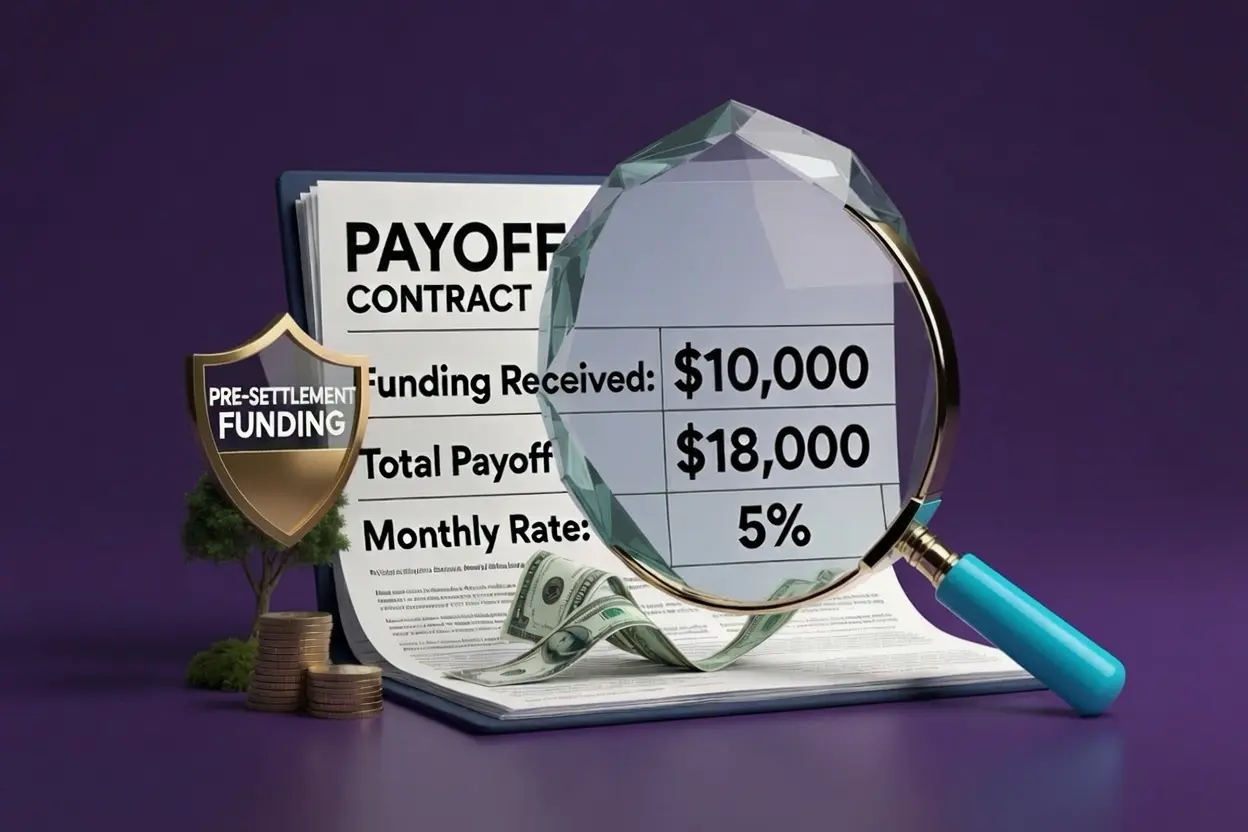
If you are looking at lawsuit funding because money is tight, a “no interest” “flat fee” offer may sound like the best deal right away.
But that claim by itself does not tell you what the funding will really cost.
What you really need to know is this: if you take money now, how much may come out of your settlement later?
That is the number to focus on.
In plaintiff funding, the real cost depends on how the agreement is structured, how long the case takes, whether more funding is added later, and what the total payoff looks like over time. So even when a company says it charges no interest and uses only flat fees, the funding can still end up costing more than an offer with simple monthly pricing.
Quick answer
“No interest” does not automatically mean lower-cost lawsuit funding.
Some companies use flat-fee pricing instead of calling the charge interest. That is just a different pricing structure. The label alone does not tell you enough. The better comparison is the total payoff under the agreement.
That is why the smartest question is not:
“Do they charge interest?”
It is:
“How much may I repay in total if my case ends in a recovery?”
Why “no interest” can be misleading
This is where many plaintiffs get tripped up.
A company may say it does not charge interest, but that does not mean the cost stays low. It may simply mean the company uses a flat fee or another charge structure instead of using the word “interest.”
That fee can still add up fast.
And if the plaintiff later takes another advance, or a new company buys out the old balance, the amount already built into that first agreement still matters.
Plus, in the market, some funding companies use repeating flat-fee periods, such as every six months, instead of monthly interest language. That is another reason the label alone does not tell you whether the funding is cheap.
The payoff does.
What does “no interest” usually mean?
Usually, it means the company is not describing the charge as interest.
Instead, it may describe the cost as:
- a flat fee
- a fixed charge
- a purchase amount
- a contractual payoff amount
That does not automatically make the agreement bad. But it also does not automatically make it cheaper.
It just means you need to look at the numbers more carefully.
Flat fee vs. interest: what is the difference?
A flat fee is usually presented as a set charge rather than an interest rate that grows month by month.
Interest-based pricing, on the other hand, is usually shown as a monthly, semi-annual or annual rate.
On paper, the flat-fee model can sound simpler. But this does not always mean lower cost.
What matters is:
- how much money you actually receive
- how much you may have to repay
- when that amount increases
- whether the agreement has a cap
- what happens if you need more money later
That is why two offers can sound completely different and still lead to the same result — or a very different one.
You might like: What Are Lawsuit Loans Fees?
Example: “no interest lawsuit funding” does not always mean cheaper
Here is a simple short-case example.
A plaintiff receives a $10,000 in lawsuit funding.
Offer A — No-interest / flat-fee structure:
Repayment after a short period: $6,500
Offer B — 2.5% simple monthly pricing:
Repayment after the same period: $6,250
Even over a short window, the “no interest” offer already costs more.
But the real difference shows up over time. Most cases do not settle in a few months. They take a year, two years, sometimes longer. So look at what happens to a $10,000 advance as the months add up.
A flat-fee schedule might be set like this:
- 25% if the case resolves by month 6 → payoff $12,500
- 45% by month 12 → payoff $14,500
- 65% by month 18 → payoff $16,500
- 85% by month 24 → payoff $18,500
A 2.5% simple monthly structure on the same $10,000 looks like this:
- Month 6 → payoff $11,500
- Month 12 → payoff $13,000
- Month 18 → payoff $14,500
- Month 24 → payoff $16,000
Now watch the gap between them:
- At 6 months, the flat fee costs $1,000 more.
- At 12 months, $1,500 more.
- At 18 months, $2,000 more.
- At 24 months, $2,500 more.
The flat-fee structure said “no interest.” But the longer the case ran, the more it pulled ahead. That is the part the label hides.
The real risk in a flat-fee contract: the step-up date
Flat-fee funding does not grow a little every month. It grows in jumps tied to dates in your contract.
That creates a trap most people never see coming. If your case settles a few weeks after one of those dates, your payoff can jump by thousands — even though nothing about your case changed.
Look again at the $10,000 schedule above. The payoff is $16,500 if the case resolves by month 18, then steps up to $18,500 in the next tier.
So a case that settles just before that date pays off at $16,500. A case that settles just a few weeks later pays off at $18,500. Those few weeks cost $2,000 — and no rate ever changed.
A simple monthly structure does not do this. Over those same few weeks, a 2.5% monthly cost moves by about $250, not $2,000. There is no cliff.
This is why the date your case is likely to settle matters as much as the rate. Before you sign a flat-fee agreement, ask for every step-up date in writing, and put those dates next to your attorney’s honest estimate of when your case may resolve. If a likely settlement window lands just past a step-up, that “no interest” contract may be the most expensive option on the table.
What if the plaintiff takes more money later?
This is one of the biggest reasons the “no interest, one time fee” pitch can become misleading.
A plaintiff may take an initial advance, then come back a couple of months later because the case is still dragging on and the bills keep coming.
At that point, the cost goes up for more than one reason:
- there is now more funded money in the deal
- the new advance is priced from that later date as its own separate charge
- the earlier balance does not disappear
- the timing of the agreement may change depending on how the contract handles new funding
So even if the original structure sounded simple, taking another advance can make the total cost much higher.
That is why you should ask how additional funding affects the balance before signing the first agreement.
What if a new company buys out the old balance?
This is another situation where the label alone does not tell the full story.
A plaintiff may come to a new funding company because the old company used a flat-fee or “no interest” structure that ended up costing more than expected. Or the old company may refuse to provide more funding.
A buyout can help. But it does not erase what already built up under the old agreement.
The old payoff still has to be satisfied first.
So if a company charged a very high flat fee early on, that amount is already part of the balance being bought out. Even if the new company offers better terms going forward, the old cost still matters.
That is why a buyout can improve the path forward without wiping the slate clean.
How should you compare a “no interest” lawsuit funding offer?
Do not compare it by the label alone.
Compare it by asking:
- How much money will I actually receive?
- How much may I have to repay?
- What does the payoff look like over time?
- Is there a cap?
- What happens if I need more funding later?
- What happens if this agreement is bought out?
Those questions tell you far more than the phrase no interest ever will.
What should you focus on instead?
When you are comparing offers, these factors usually matter more than whether a company uses the word interest:
1. The total payoff
This is the most important number.
2. Whether the pricing is easy to understand
If you cannot clearly follow how the cost works, that is a problem.
3. Whether there is a cap
A clear cap gives you more predictability.
4. How additional advances are handled
A later advance can change the economics of the deal.
5. Whether the agreement is being bought out
Old charges do not disappear just because a new company steps in.
So is “no interest” bad?
Not automatically.
The problem is if you’re led to believe that no interest always means the lowest cost pre-settlement funding.
It does not.
Sometimes a flat-fee structure may be competitive. Other times it may cost much more than a simple-interest agreement. The only honest way to compare the offers is to look at the actual numbers.
The bottom line
If a company says it offers no interest lawsuit funding, do not assume that means the funding costs less.
It may simply mean the company is using a different label for its charges.
The better way to compare offers is to look at the total payoff, how the agreement works, whether there is a cap, and how added funding or a buyout may affect the final cost.
That is how you get a clearer picture of what may really come out of your settlement later.
FAQ
Does “no interest” lawsuit funding mean there are no charges?
No. It usually means the company is not describing the pricing as interest. There may still be flat fees or other built-in charges in the agreement.
Can a flat-fee funding agreement charge every 6 months?
Yes. Some companies use flat-fee pricing in repeating periods, such as every six months, instead of describing the charge as monthly interest. That is why the label alone does not tell you whether the offer is cheaper. You still need to look at the total payoff.
Is flat-fee lawsuit funding always cheaper than interest-based funding?
No. A flat-fee agreement can cost more or less depending on the structure and the total payoff.
What matters more than whether a company says “no interest”?
The most important number is the total payoff — how much may be repaid from your settlement if your case ends in a recovery.
Can additional funding make a “no interest” deal more expensive?
Yes. Taking another advance later can increase the total balance and change how the overall cost adds up.
Does a buyout erase the cost of the old agreement?
No. A buyout may improve the terms going forward, but it does not erase what already built up under the old agreement.