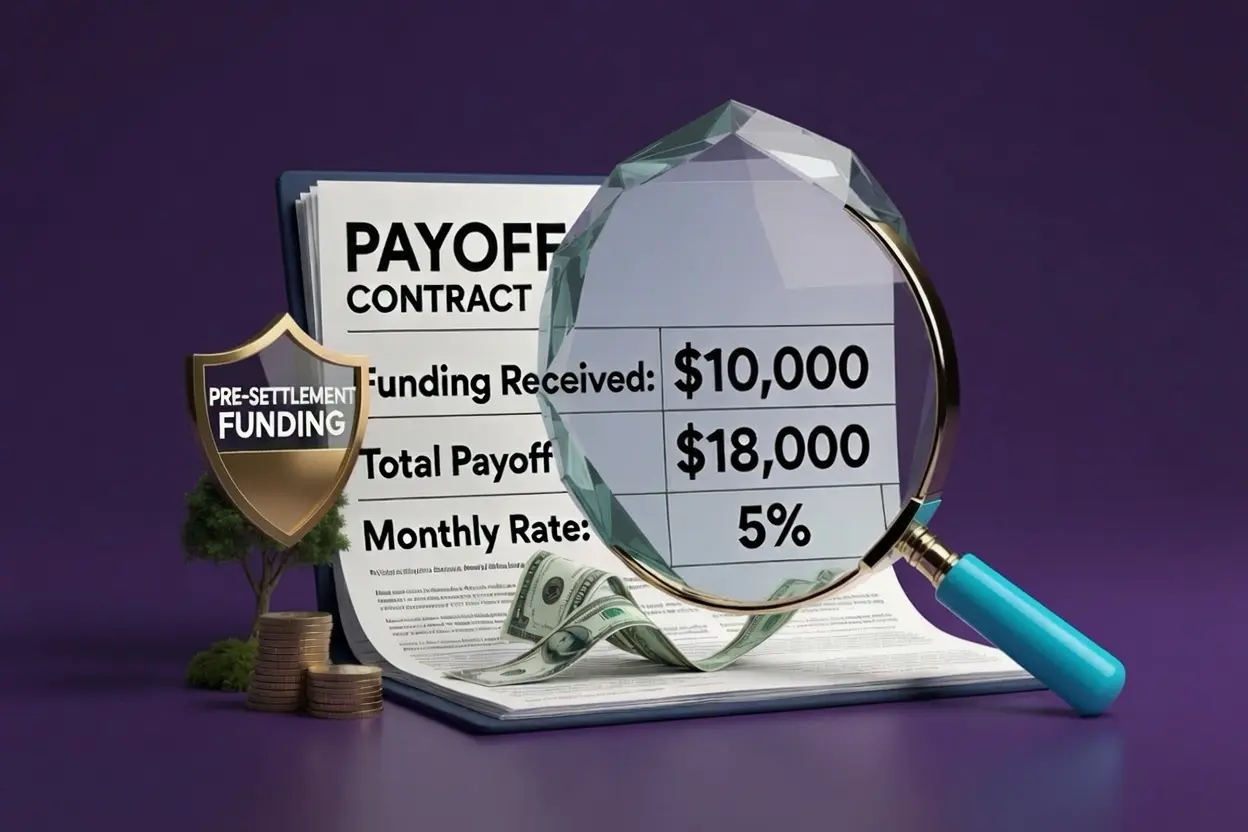
If you are asking what lawsuit loan fees are, you are probably trying to figure out one thing: what extra charges may be built into the agreement, and how they affect what comes out of your settlement later.
Fees can matter. But they are only one part of the total cost. A funding agreement with fees is not automatically more expensive than one without fees, and a “no-fee” offer is not automatically the better deal.
What matters most is the full payoff under the agreement.
Lawsuit loan is the common term, but these agreements are structured as non-recourse pre-settlement funding. That means there are no monthly payments while your case is pending, and repayment comes from your settlement or award if your case ends in a recovery.
Quick answer
Lawsuit loan fees are charges that may be included in the funding agreement in addition to the amount advanced.
Depending on the company and the structure, those charges may be described as:
- origination fees
- underwriting fees
- servicing fees
- wire or transfer fees
- flat fees
- administrative fees
Not every company uses the same pricing model. Some rely more on interest-style pricing. Others use flat-fee language. Some combine fees with other charges.
That is why the best question is not just, “Are there fees?”
It is, “How much may I repay in total under this agreement?”
Are lawsuit loan fees paid upfront?
They should not be paid out of pocket upfront in a plaintiff funding agreement.
If you are being asked to send money before funding is approved or before funds are sent, that is a huge red flag.
In a legitimate non-recourse plaintiff funding structure, charges are disclosed in the agreement and repaid from the settlement or award if there is a recovery. They are not supposed to function like an upfront application payment from your pocket while your case is still pending.
What kinds of fees may appear in a lawsuit funding agreement?
The wording depends on the company, but these are some of the labels you may see.
Origination fee
This is a charge tied to setting up the funding agreement.
Underwriting fee
This is a charge some companies use for evaluating the case and issuing the advance.
Wire or transfer fee
This covers sending the money once the agreement is complete.
Servicing or administrative fee
This may be described as a charge connected to maintaining or processing the account.
Flat fee
Some companies do not describe their pricing as interest. Instead, they use flat-fee language. That does not automatically make the funding cheaper. It just means the pricing is being described differently.
Remember, the label matters less than the actual dollars.
Fees are not the same as interest
This is where people often get confused.
A fee is a charge listed in the agreement. Interest is a charge that builds according to the pricing structure in the contract. Some companies use one, some use both, and some avoid the word “interest” entirely and rely on flat-fee language instead.
That is why you should not compare offers by labels alone.
A contract with fees can still cost less overall than a no-fee contract if the pricing is lower, the structure is simpler, or the cap is shorter. On the other hand, a no-fee contract can still cost more if the rate is higher or the balance grows longer.
That is why the better question is always the same: how much may be repaid in total under the agreement?
You might like: Simple vs. Compound Interest in Pre-Settlement Funding
Do lawsuit loan fees always make the deal more expensive?
No.
Fees affect the cost, but they do not decide the deal by themselves.
For example, one offer may include a fee but still leave you with a lower total payoff than another offer with no fee at all. That can happen if the first offer has a better pricing structure, a shorter cap, or lower overall charges over time.
So the right comparison is not:
- fee vs. no fee
The right comparison is:
- total payoff vs. total payoff
That is the number that tells you what may actually come out of your settlement.
You might like: How Much Do Lawsuit Loans Cost?
Why fees alone do not tell you the real cost
A fee is only one piece of the agreement. But a lawsuit loan fee by itself does not tell you whether a funding offer is cheap or expensive.
Some agreements include fees and still cost less overall. Others use “no fee” or “no interest” language and still end up costing more once you look at the full structure of the deal.
To understand your real cost, you need to understand:
- how the charges are calculated
- whether the pricing is simple, compound, tiered, or flat-fee
- whether the agreement has a cap
- what the payoff may look like over time
- what happens if you take another advance later
- whether an older funding balance is being bought out
Two offers can look similar at first and still end very differently.
Example: why one fee does not tell the whole story
In pre-settlement funding buyouts, we often see contracts marketed one way and priced another way once the full payoff is reviewed.
For instance, two companies may both offer a $5,000 settlement advance.
- One says it charges no fees.
- The other says the agreement includes a fee.
That still does not tell you which offer costs less.
The no-fee offer may use a higher rate, tiered pricing, or terms that become more expensive if the case takes longer. The fee-based offer may still cost less overall if the pricing is lower, the structure is simpler, or the cap is shorter.
That is why you should not compare offers by one label alone. The better question is how much may be repaid in total under the agreement if your case ends in a recovery.
You might like: No Interest” Lawsuit Funding? What That Claim Really Means
What about “no interest” or “no fee” offers?
Be careful with labels.
A company may say it charges no interest, or no fees, and still end up costing more overall depending on how the agreement works. That is why the better question is always the same:
How much may I repay in total under this agreement?
That keeps the focus on the real cost instead of the marketing language.
What should you check about fees before you sign?
Before you sign any legal funding agreement, make sure you understand:
- what charges are included
- how those charges are described in the agreement
- whether any fees are added one time or can affect the balance over time
- whether the agreement has a clear cap
- whether the contract shows what repayment may look like at different points in time
You and your attorney should be able to review the agreement and understand how those charges may affect the total payoff before you sign.
Compare the real cost with Baker Street Funding
A low-fee or no-fee label does not always mean a lower-cost deal. Baker Street Funding helps approved plaintiffs review competitive pricing, clear caps, and terms that are easier to understand before they sign.
The bottom line
Lawsuit loan fees are charges that may appear in the funding agreement in addition to the amount advanced.
They matter, but they do not tell you the full story by themselves.
To understand the real cost, you need to look at the full agreement, including the pricing structure, any fees, the cap, and the total payoff over time.
That is the clearest way to compare one funding offer against another and protect more of your settlement later.
FAQ
What are lawsuit loan fees?
They are charges that may be included in the funding agreement, such as origination, underwriting, transfer, servicing, administrative, or flat-fee charges.
Are lawsuit loan fees paid upfront?
They should not be paid out of pocket upfront in a typical plaintiff funding agreement. Charges are usually disclosed in the contract and repaid from the settlement or award if there is a recovery.
Are fees the same as interest?
No. Fees and interest are different types of charges. Some companies use one, some use both, and some use flat-fee language instead of interest terminology.
Does a no-fee lawsuit loan always cost less?
No. A no-fee offer can still cost more overall if the pricing is higher or the balance grows longer. The better comparison is the total payoff.
What is the best way to compare lawsuit loan fees?
Compare the full agreement, not just the fee label. Look at how the charges work, whether the agreement has a cap, and what the total payoff may look like over time.
What should I ask before signing?
Ask how the charges are calculated, what fees are included, whether the agreement has a cap, and what repayment may look like at different time points if your case ends in a recovery.