While you’re waiting on your personal injury settlement and the bills keep coming, seeing an interest rate quote can feel overwhelming.
You’re probably trying to figure out one thing: what kind of pricing people usually see and whether the offer in front of you is reasonable.
The short answer is that settlement loan rates vary a lot. The rate depends on the type of funding, the risk of your case, how the company prices the advance, and how long your case may take to resolve.
Remember, this is pre-settlement funding. You only pay it back from your settlement if you win or settle. Nothing is owed if the case doesn’t recover.
What is the average interest rate on a settlement loan?
There is no single industry-wide rate that applies to every settlement loan.
That is because “settlement loan” is a broad term. Some people use it for pre-settlement funding (money while your case is still ongoing). Others mean post-settlement funding (money after the case has settled but the check hasn’t arrived).
Those two types do not price the same way.
In general:
- Pre-settlement funding usually costs more because repayment depends on the outcome of an active case.
- Post-settlement funding often costs less because the risk is lower.
If you are comparing quotes, first ask which type of funding you are actually looking at.
Why rates vary so much
Settlement loan pricing is not based on your credit score the way a bank loan is. It is based on your case itself.
That includes:
- the strength of liability
- available insurance coverage
- the likely case value
- how long the case may take
- whether there are existing liens or prior funding balances
- whether the attorney is cooperating with the review
A stronger case with clear insurance and a shorter timeline often qualifies for better pricing. A more complex case with higher risk usually does not.
Why the “average” does not tell the whole story
Average pricing gives you useful context. But it should not be the only thing you look at.
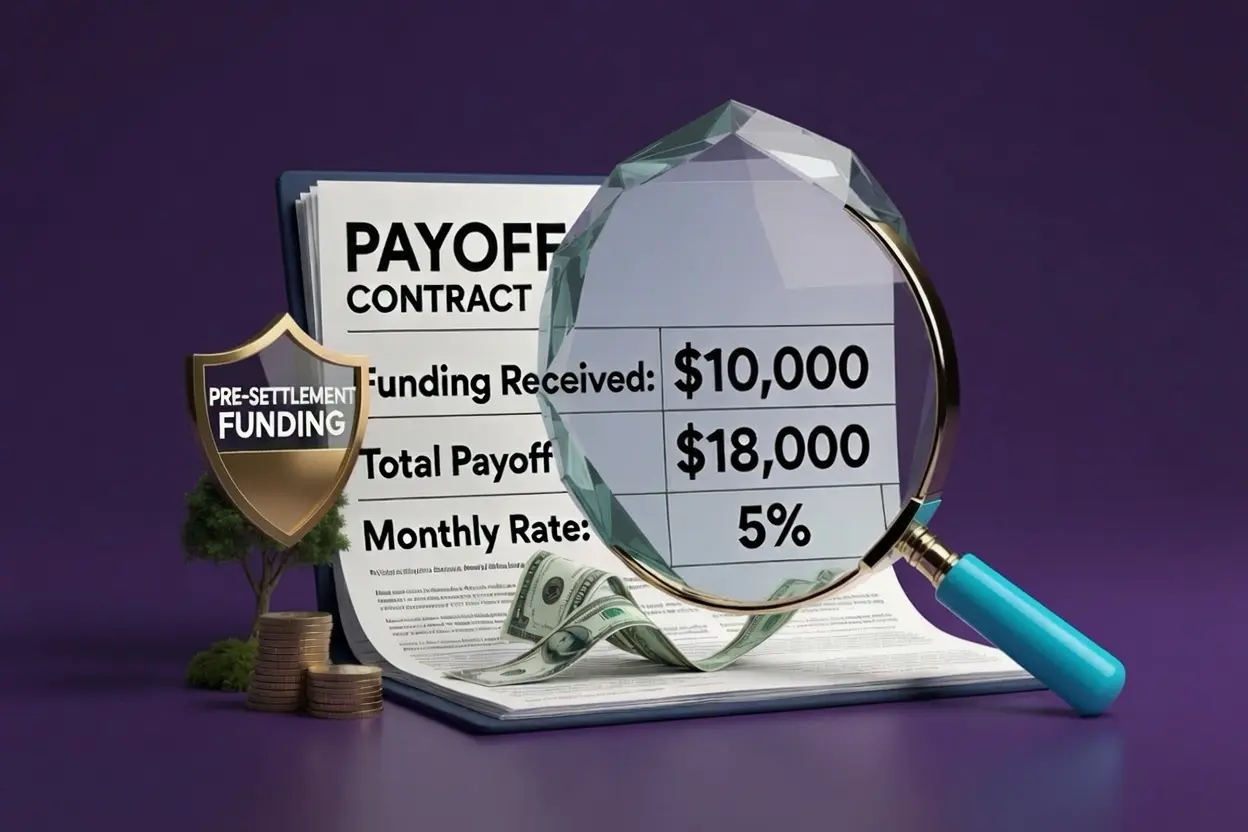
Two companies can quote the same general range and still leave you with very different payoffs. That is because the real cost depends on more than the starting rate.
The way charges are calculated matters just as much as the rate. It also depends on factors like the type of rates, added fees, caps, and additional costs if you take another advance later.
That is why a quote that sounds average on the surface can still end up costing more than expected.
You might like: Types of Interest Rates for Pre-Settlement Funding and How Much Lawsuit Loans Really Cost
What is a “good” rate on a settlement loan?
A good rate is not just a low-looking monthly number.
A good rate is one that comes with terms you can clearly understand and compare.
For pre-settlement funding, stronger plaintiff pricing in Baker Street Funding’s 2026 buyout data generally starts around 2.95% per month and can go up to about 3.4% per month, depending on the case. That works out to roughly 36–41% annually at the lower end.
Those numbers are not a fixed rate for every case. They are a real-world benchmark from actual buyouts.
And remember, this is pre-settlement funding, not a traditional loan. You only pay it back from your settlement if you win your case. If you don’t win, you owe nothing. It’s as simple as that.
You might like: Simple vs. Compound interest in Pre-Settlement Funding
How to compare settlement loan quotes the right way
If you are shopping around, do not stop at the monthly rate.
Before you sign anything, it’s important to understand the agreement and how much of your settlement will go toward repaying the advance. Consider looking at how charges are calculated, whether any fees apply, whether there is a cap, and what the payoff may look like over time.
That gives you a much better way to compare one quote against another.
Pre-settlement vs. post-settlement rates
Pre-settlement funding
Pre-settlement funding applies while your case is still active.
This type of funding usually costs more because repayment depends on the outcome of the case. If there is no recovery, there is no repayment obligation, which means the funding company is taking more risk.
Post-settlement funding
Post-settlement funding applies after the case has already settled, but the money has not arrived yet.
Because the case is already resolved, the funding company is taking a lower risk. That is why post-settlement funding often comes with lower pricing than pre-settlement funding.
The important thing is not to compare one type against the other as if they are priced the same. They are not.
What else should you watch for?
Even an average-looking rate can become expensive if the agreement is not clear.
Be careful with offers that:
- advertise a low starting rate but increase sharply later
- make it hard to understand how the balance grows
- bury fees
- do not explain whether there is a cap
- make it difficult to see what repayment may look like over time
A transparent agreement matters just as much as the number itself.
The bottom line
The average interest rate on a settlement loan depends on the type of funding and the details of the case.
For pre-settlement funding, Baker Street Funding’s 2026 buyout data shows an average annual interest cost of around 60%, while stronger plaintiff pricing generally starts around 2.95% per month.
That gives you a useful benchmark. But the best way to judge any quote is to look beyond the average and compare the actual agreement.
The interest rate matters. But the structure, fees, cap, and total payoff matter just as much.
Ready to move forward with pre-settlement funding you can trust?
You don’t have to keep wondering whether the offer in front of you is fair while medical bills, rent, and lost wages pile up.
Apply with Baker Street Funding today and get a clear quote based on your case.
We’ll review your lawsuit details, show you exactly how much you could receive, and explain the full agreement in plain language. The best part? You only pay back the funds if you win your case. If you don’t recover a settlement or judgment, you owe us nothing. It’s that simple and risk-free.
Take back control of your finances while you wait. Apply now and see where you stand — it takes just a few minutes.
FAQ
What is the average interest rate on a pre-settlement loan?
There is no single fixed rate across the industry. Based on Baker Street Funding’s 2026 buyout data, the average annual interest cost of a pre-settlement cash advance is around 60%, while stronger plaintiff pricing generally starts around 2.95% per month and can go up to about 3.4% per month, depending on the case.
Is pre-settlement funding more expensive than post-settlement funding?
Usually, yes. Pre-settlement funding often costs more because repayment depends on the outcome of an active case. Post-settlement funding carries less risk because the case has already settled.
Why do settlement loan rates vary so much?
Pre-settlement funding rates vary because pricing depends on the case itself, including liability, insurance coverage, expected value, timing, and overall risk.
Is the lowest monthly rate always the best deal?
No. The lowest-looking rate does not always mean you’ll walk away with more money in your settlement. The real cost depends on how the charges are calculated, any added fees, and how long your case takes.
How should you compare settlement loan quotes?
Compare the full agreement, not just the advertised rate. Look closely at whether there is a cap, how fees work, and what the actual payoff would be at different time frames. The clearest agreement usually serves you best.