You can apply for a lawsuit loan in about five minutes online or by phone, and most approved plaintiffs receive funds within 24 to 48 hours after their attorney sends the case file. The application itself is short. What takes time is the underwriting review, the attorney coordination, and the contract review. This guide walks you through the full process step by step — what you do, what we do, what your attorney does, and realistic timing for each stage.
If you’re earlier in the process and not sure what documents your attorney will need to send, see our complete documents checklist. If you want to know whether you qualify before starting, see how to qualify for a lawsuit loan.
Before you apply: three things to confirm
These three confirmations save the most common application headaches:
- You’re represented by an attorney on contingency. No exceptions. Funding requires attorney participation because they handle disbursement of repayment from the settlement.
- Your case is worth at least $50,000 estimated. Baker Street Funding’s minimum case value is $50,000. Smaller cases generally aren’t fundable because the cost outweighs the benefit.
- Your case has a defendant with insurance. A winning verdict against an uninsured, unrecoverable defendant has no real value for funding purposes.
If any of these aren’t yet true, hold the application until they are. Applying too early is a top denial reason. See top reasons plaintiffs get denied.
Step 1: Apply online or by phone (5–10 minutes)
The application itself is short. We ask for:
- Your name, contact information, and state
- Your attorney’s name, firm, and phone number
- Type of case (car accident, slip-and-fall, medical malpractice, civil rights, etc.)
- Date of the incident
- Brief description of what happened
- How much funding you’re looking for and what you need it for
That’s it. No credit check, no income verification, no documents requested from you. You can apply online or call (888) 711-3599.
What we do behind the scenes: Your application is routed to a funding specialist within minutes. They do a preliminary review for case type, state eligibility, and obvious red flags. If everything looks workable, your application moves to underwriting in under an hour.
What speeds this step up: Having your attorney’s contact info handy and being clear about your case type and approximate value. If you’re unsure about case value, your attorney can give you a rough estimate before you apply.
Step 2: We coordinate with your attorney (same day, usually within hours)
Your specialist contacts your attorney’s office to request the case file. With your consent, we work directly with your lawyer to gather:
- The complaint, summons, or demand letter
- The police or incident report
- Medical records (so far)
- Insurance information
- Settlement correspondence (if any)
You don’t gather any of this. Your attorney’s office handles it on their end.
What we do behind the scenes: While waiting for the file, our underwriters begin researching the venue, defendant insurance carrier, recent comparable verdicts in your state, and any preliminary case-type considerations.
What speeds this step up: This is by far the biggest variable in your timeline. A quick call or email from you to your attorney’s office — “Baker Street Funding is reaching out for my case file, please send it as soon as you can” — moves things faster than any reminder we can send. If your attorney is in trial or out of office, the case file can sit on a paralegal’s desk for days. Your voice cuts through.
Step 3: Underwriting review (a few hours to 1 business day)
Once the case file arrives, our in-house underwriters analyze:
- Liability — Is fault clear, contested, or shared? In comparative-fault states, what percentage do we project?
- Damages — Severity of injuries, treatment trajectory, lost wages, future care needs
- Insurance and collectibility — Defendant’s policy limits, umbrella coverage, asset picture
- Timeline — How long until trial or expected settlement? Is your statute of limitations protected?
- Net recovery math — After attorney fees, liens, prior advances, and our payoff, will you still walk away with a meaningful net? If not, the advance is reduced or declined.
What we do behind the scenes: Our underwriters often call your attorney to clarify specific points. This is normal and a good sign — it means we’re seriously evaluating, not auto-declining. For the deeper view of what an underwriter is actually looking at, see [pre-settlement funding underwriting → /what-is-pre-settlement-funding-underwriting/].
Typical timing: Decisions usually come within hours of receiving a complete file. Complex cases (multi-defendant, contested liability, very large value) can take a full business day or more.
What speeds this step up: A complete file. If your attorney sends a fragmentary file with key documents missing, the clock pauses while we wait for the rest.
Step 4: Review the contract with your attorney (1–4 hours)
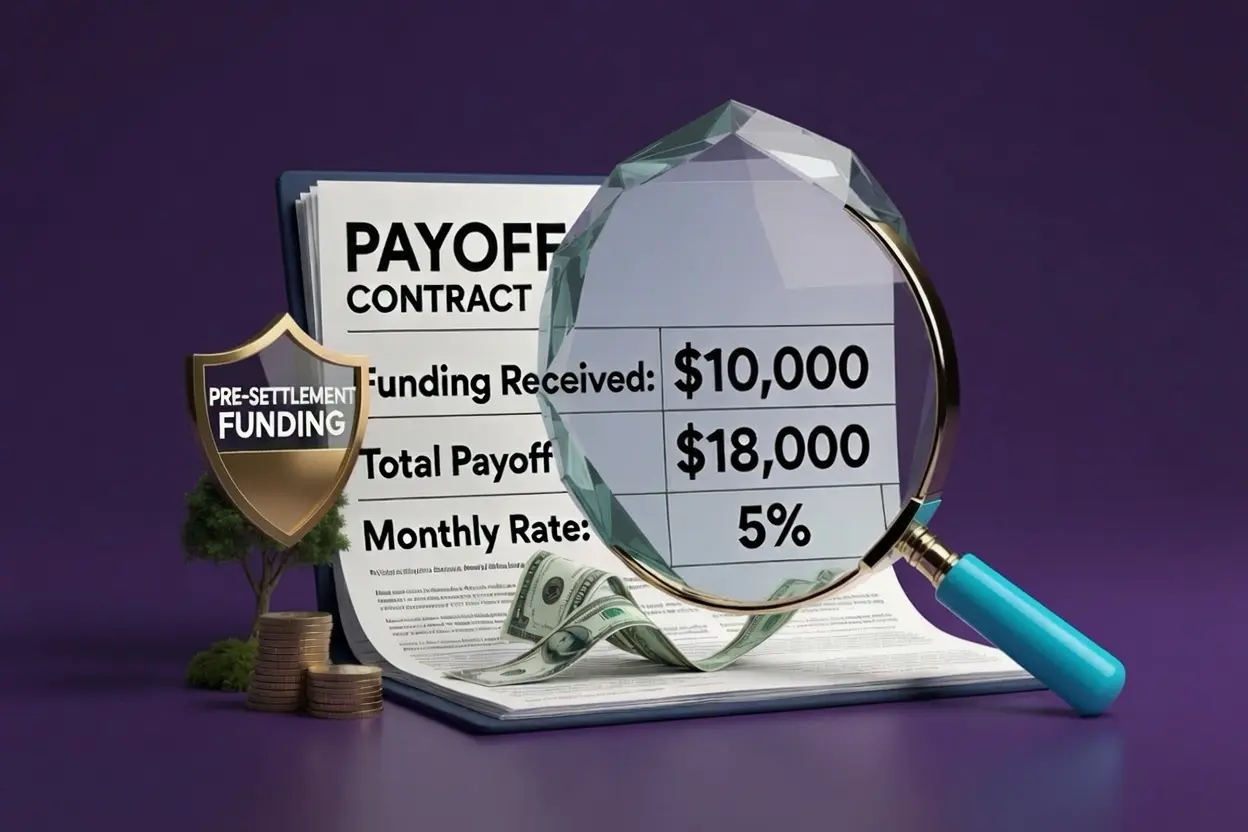
If approved, we send a written contract showing every detail of the offer:
- The principal amount being advanced
- The rate (typically 2.95% per month, non-compounding) and the type of interest in plain English
- The 2 or 3-year cost cap — fees stop accruing after month 24 or 36 (depending on your contract)
- Projected payoff amounts at 12, 24, and 36 months so you can see exactly what you’d owe at each milestone
- The non-recourse clause — no repayment if you lose
- The rescission window — you have 5 business days to cancel (10 days in some states)
- The lien acknowledgment your attorney signs
What you do: Read it. All of it. Ask questions. We expect questions and our specialists are paid to answer them, not to rush you.
What your attorney does: Reviews the contract, confirms it’s reasonable and consistent with their understanding of your case, and signs the lien acknowledgment.
What speeds this step up: Calling your specialist with questions instead of sitting on the contract for days while you’re confused. Most contract questions are resolved in a 10-minute conversation.
Step 5: Sign and get funded (hours after signing)
Once you and your attorney sign, funds are released within hours.
- Wire transfer: Same-business-day funding if signed before mid-afternoon. Funds typically hit your account within 2–4 hours of disbursement.
- Check by overnight mail: Next-business-day delivery. Useful if you don’t have a bank account ready to receive a wire.
We confirm receipt with you directly. You can spend the funds however you choose — there are no restrictions. See how to use lawsuit funding.
What if I’m denied?
A denial is not the end of the road. The most common reasons we decline:
- Case too early — apply again once the complaint is filed or initial medical records are gathered
- Insurance question — the defendant’s coverage is unclear; resubmit once your attorney has the declaration page
- Comparative fault concerns — the case may still be fundable for a smaller amount
- State maximum reached — Illinois, for example, caps funding at $40,000
What you can do: Ask for the specific reason in writing. Most denials we issue are reversed once the underlying issue is addressed. You can also apply with a different funder — different companies have different state restrictions, case-type preferences, and underwriting standards. See what to do if you’ve been declined.
How long does the whole process actually take?
For most plaintiffs with a cooperative attorney and a complete case file:
| Stage | Realistic timing |
|---|---|
| Application | 5–10 minutes |
| Attorney coordination | Same day to 2 business days (depends on attorney) |
| Underwriting review | A few hours to 1 business day |
| Contract review | 1 hour to 1 business day |
| Signing to deposit | 2–4 hours (wire) or next business day (check) |
| Total realistic range | 24 to 48 hours, sometimes same day |
The 24-hour scenario happens when everything aligns: attorney responds immediately, underwriting is clean, contract is signed before mid-afternoon, and bank wires post the same day. The 5-day scenario happens when the attorney’s office is slow or the file is incomplete.
For the full timeline breakdown, see how long does it take to get a lawsuit loan.
Ready to start?
If your case meets the basic criteria — represented by counsel, $50,000+ estimated value, defendant with insurance — the next step takes about five minutes. Apply online or call (888) 711-3599 to speak with a specialist.
There are no upfront fees, no obligation, and the decision is yours either way. If your case qualifies, you’ll have a written contract to review with your attorney within hours. If it doesn’t, we’ll tell you exactly why so you can address it or consider other options.
Frequently asked questions
Can I apply if my lawsuit hasn’t been filed yet?
Yes, in some cases. Strong pre-suit cases with retained counsel and substantial documentation (police report, medical records, clear liability) can qualify. Filing typically increases the advance amount because case value becomes more established.
Do I need my attorney’s permission to apply?
You don’t need permission to apply, but you do need your attorney to participate — they must acknowledge the lien and handle disbursement at settlement. We strongly recommend talking to your attorney before applying so they know the call is coming.
How is the process different for settled cases?
For settled cases waiting on disbursement, the application is shorter because the case value is already known. We need the signed settlement agreement, the lien acknowledgment, and the estimated disbursement date. Rates are typically lower than pre-settlement because the risk is much lower. See post-settlement funding.
What if I need monthly payments instead of a lump sum?
For larger cases (typically $150,000+ estimated), we can structure the advance as scheduled monthly disbursements instead of one lump sum. Fees only accrue on funds already disbursed.
Will applying hurt my credit score?
No. We don’t run credit checks or pull credit reports. There is no inquiry of any kind on your credit report. Your credit score is unaffected.
What if my attorney won’t cooperate?
Most attorneys cooperate readily. If yours won’t, the first step is asking why — sometimes there’s a specific concern about your case timing or a state regulation. If they refuse outright, you may need to either wait until your case is further developed or, in rare cases, consider whether the attorney-client fit is right.
This article is for informational purposes only and is not legal or financial advice. All funding decisions, terms, and timelines are subject to Baker Street Funding’s underwriting review and written agreement. Consult your attorney before signing any funding contract.