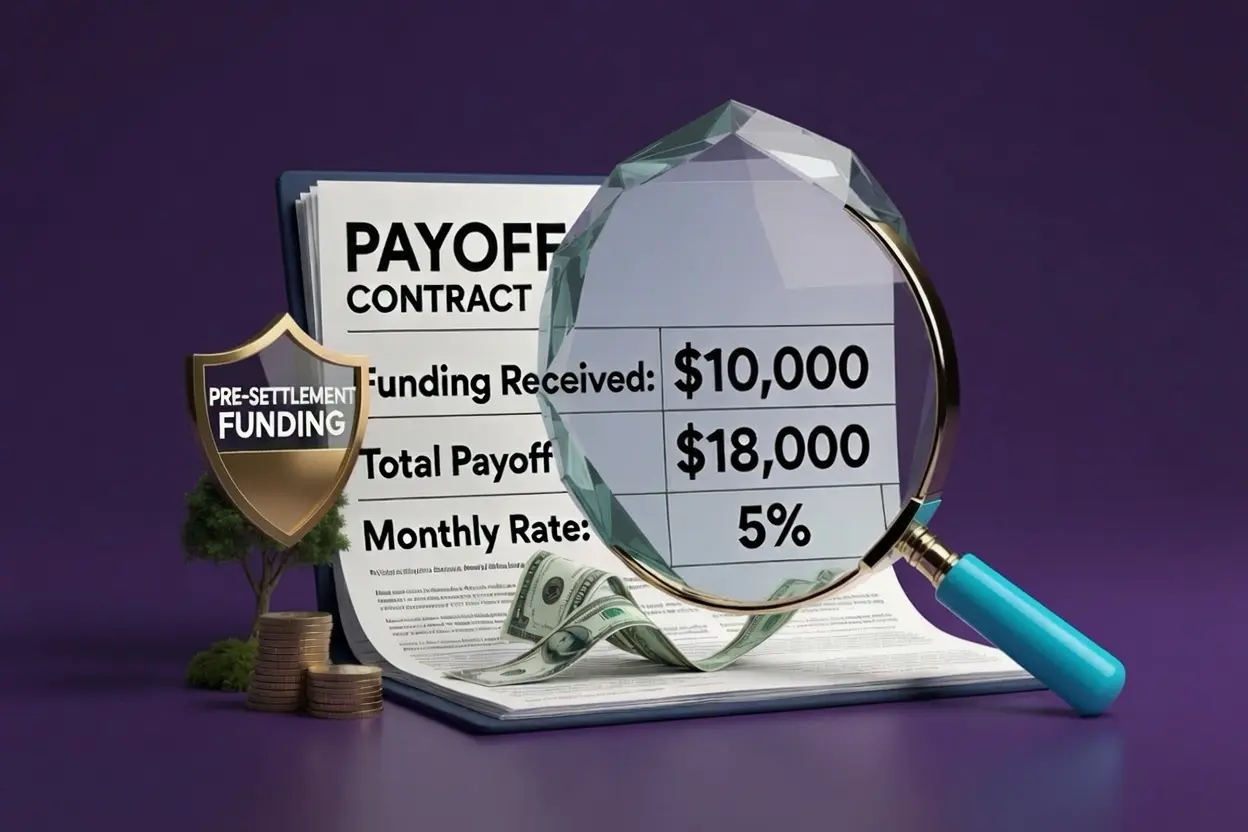
If you’re applying for pre-settlement funding, the documents your attorney sends us are what decide how fast you’re approved, how much we can advance, and what rate we can offer. The good news: you don’t have to gather any of these yourself. Once you give consent, we coordinate directly with your attorney’s office.
*This article is a reference so you understand what’s being collected, why each document matters, and what to do if any are missing.
Quick navigation
- The four documents every case needs
- Documents we don’t need (and never ask for)
- Motor vehicle accident cases
- Premises liability and slip-and-fall
- Medical malpractice
- Wrongful death
- Wrongful imprisonment and civil rights
- Police brutality, false arrest, and excessive force
- Workers’ comp and work-related injury
- Maritime, Jones Act, and FELA
- Product liability and defective product
- Nursing home negligence
- Employment cases (wrongful termination, discrimination)
- Settled cases (post-settlement funding)
- What happens if a document is missing
- Frequently asked questions
The four documents every case needs
Regardless of case type, our underwriters always need these four building blocks. If you don’t have one, that’s the first conversation to have with your attorney before applying:
- Proof the incident happened. Usually a police report, incident report, or EMS run sheet. For non-injury cases, it may be a complaint filed with the court or a demand letter.
- Proof you were hurt. Emergency room records, initial evaluation, or — in civil rights cases — documentation of the underlying wrong (certificate of innocence, body cam footage, etc.).
- Proof someone insured (or financially capable) is responsible. An insurance declaration page showing coverage limits, or in non-insurance contexts, proof of the defendant’s assets or government liability.
- A clear path to a settlement. Either an attorney-prepared demand letter, a filed complaint, or a documented pre-litigation negotiation. Without this, we can’t underwrite.
If those four exist in some form, the case is almost always fundable. Everything below is the case-type-specific layer on top of these basics.
Documents we don’t need (and never ask for):
Just as important as what we need — what we don’t:
- No tax returns. Income doesn’t affect eligibility.
- No pay stubs or proof of employment. We don’t verify employment.
- No bank statements. Account balances aren’t a factor.
- No credit report or credit check. Approval is based entirely on the case.
- No collateral. Your car, home, and personal assets are not pledged. The lawsuit is the only security.
- No upfront fees. Period. If any company asks for money upfront, walk away and report it.
For the deeper breakdown of why pre-settlement funding doesn’t work like a traditional loan, see what is a settlement loan and how does it work.
Motor vehicle accident cases
The most common case type we fund. Includes car accidents, truck and 18-wheeler crashes, motorcycle accidents, Uber and Lyft, pedestrian, rear-end, head-on, and rollover.
Critical documents:
- Police or crash report (officer’s narrative establishes preliminary fault)
- Insurance declaration page (defendant’s policy limits drive the case ceiling)
- Emergency room report or initial medical evaluation (documents injuries within days of incident)
- Filed complaint or attorney demand letter
Helpful documents:
- MRI, CT scan, and X-ray reports
- Post-operative reports (if surgery has occurred)
- Photographs of the vehicles and scene
- Witness statements
- Property damage estimates (corroborate impact severity)
What can slow underwriting: Disputed liability (both drivers blaming each other), low policy limits ($25K/50K minimums in your state), or treatment gaps of more than 60 days between the accident and your first doctor visit.
Premises liability and slip-and-fall
Includes slip-and-falls at supermarkets, trip-and-falls, falling objects, staircase injuries, and inadequate security claims.
Critical documents:
- Incident report from the property owner or store (often the single most important piece)
- Photos or video footage of the hazard (water, ice, broken step, etc.)
- Insurance declaration page for the property
- Medical records showing injury within 24–72 hours of the fall
- Demand letter or filed complaint
Helpful documents:
- 911 call audio or transcript
- EMS run sheet
- Witness contact information and statements
- Prior complaints about the same hazard (powerful — shows notice)
What can slow underwriting: No incident report (the most common problem on slip-and-falls), no contemporaneous medical treatment, or the property owner being uninsured.
Medical malpractice
Higher-value but more complex to fund — these cases live or die on expert testimony.
Critical documents:
- Expert affidavit or certificate of merit (required in most states)
- Filed complaint or summons and complaint
- Bill of particulars (where required by state procedure)
- Defendant’s malpractice insurance information
- Supporting medical records
Helpful documents:
- Prior treatment records (establishing baseline before the malpractice)
- Operative reports and pathology
- Subsequent corrective treatment records
- Statute of limitations confirmation from your attorney
What can slow underwriting: Pre-suit cases without an expert opinion yet, contested causation (was the bad outcome from the malpractice or from the underlying condition), and states with damage caps that limit recovery. See pre-settlement funding for medical malpractice.
Wrongful death
The plaintiff is usually a surviving spouse, child, or estate representative.
Critical documents:
- Death certificate (cause of death is the cornerstone)
- Medical records leading up to death
- Defendant’s insurance information
- Letters of administration or probate court order (if the estate is plaintiff)
- Filed complaint or demand letter
- Expert report (if medical or product causation is in dispute)
Helpful documents:
- Economic loss report (lost income calculation by a forensic economist)
- Surviving family member affidavits
- Funeral and burial expenses
For more, see wrongful death lawsuit funding.
Wrongful imprisonment and civil rights
Includes exoneration cases, false conviction settlements, and 42 U.S.C. § 1983 actions against government defendants.
Critical documents:
- Certificate of innocence or order vacating conviction
- Underlying criminal court records establishing wrongful conviction
- Filed § 1983 civil complaint
- Notice of claim (where state law requires it — varies by jurisdiction)
- Documentation of damages (years incarcerated, lost income, post-release expenses)
Helpful documents:
- DNA exoneration reports
- Brady violation documentation (suppressed evidence)
- Prosecutorial misconduct findings
- Comparable settlement data from similar exoneration cases
These are high-value, long-timeline cases — often a strong fit for scheduled monthly advances rather than a single lump sum. See wrongful imprisonment funding.
Police brutality, false arrest, and excessive force
Critical documents:
- Body-worn camera or dash cam footage (when available)
- Arrest report and booking documents
- Filed § 1983 federal complaint
- Notice of claim filed with the municipality (most jurisdictions require 90 days)
- Medical records showing injuries
Helpful documents:
- Internal affairs investigation findings
- News coverage or witness video
- Prior complaints against the same officer or department
- Expert use-of-force analysis
For more, see police brutality funding and false arrest funding.
Workers’ comp and work-related injury
Workers’ compensation is funded only in limited circumstances — typically where there’s also a [third-party liability claim → /personal-injury-loans/work-related-accidents/] (a contractor’s defective equipment, a delivery truck driver who hit you on the job, a property owner’s negligence at the job site).
Critical documents:
- Workers’ comp claim filing and acceptance notice
- Independent medical examination (IME) reports
- Third-party defendant identification and insurance information (this is what makes the case fundable)
- Medical records and lost-wage statements
Helpful documents:
- OSHA report (if applicable)
- Employer’s incident report
- Vocational expert reports
Important: Pure workers’ comp without a third-party claim is generally not fundable. See workers’ comp cash advance.
Maritime, Jones Act, and FELA
Federal causes of action for seamen, longshoremen, and railroad workers. Different documentation than standard injury claims.
Critical documents:
- Crew member status documentation (Jones Act) or railroad employment records (FELA)
- Vessel logs or incident reports
- Filed complaint under the applicable federal statute
- Medical records
- Insurance information (often the employer/operator’s P&I or self-insurance)
Helpful documents:
- Coast Guard reports (maritime)
- Federal Railroad Administration reports (FELA)
- Maintenance and cure records
- Expert reports on vessel/track safety
See Jones Act maritime funding and FELA funding.
Product liability and defective product
Includes defective drugs, medical devices, vehicles, machinery, and consumer products.
Critical documents:
- The product (preserved evidence) or detailed product identification
- Filed complaint
- Manufacturer and distributor insurance information
- Expert engineering or causation report
- Medical records linking the injury to the product
Helpful documents:
- FDA recall notices or warnings (if applicable)
- Mass tort or MDL inclusion documentation (if joined)
- Prior reported incidents involving the same product
For more, see product liability funding.
Nursing home negligence
A growing case type, often involving elderly or vulnerable plaintiffs.
Critical documents:
- Admission and care plan records
- Facility incident reports
- Photographs of injuries (especially bedsores, fractures, organ damage)
- State licensing complaint records
- Death certificate (if applicable)
- Defendant facility’s insurance information
Helpful documents:
- State survey reports of the facility (often public record)
- Family-member affidavits documenting decline
- Staff-to-patient ratio records
See nursing home negligence funding.
Funded less often than personal injury but eligible when the case has documented merit and the employer has assets.
Employment cases (wrongful termination, discrimination, harassment)
Critical documents:
- EEOC right-to-sue letter or state agency equivalent
- Filed complaint
- Employment contract or offer letter
- Termination notice or relevant disciplinary documentation
- Pay records (to calculate lost wages)
Helpful documents:
- Internal complaints filed before termination
- Emails or texts showing discriminatory or retaliatory intent
- Witness statements from co-workers
- Comparable-employee data (similarly situated employees treated differently)
See wrongful termination funding and employment discrimination funding.
Settled cases (post-settlement funding)
For cases where settlement has been reached but the check has not yet been disbursed. Rates are typically lower than pre-settlement because the risk is much lower.
Critical documents:
- Signed settlement agreement or release
- Attorney lien acknowledgment
- General release executed by all parties
- Estimated disbursement date from defendant or carrier
- IOLTA disbursement plan from your attorney
For more, see post-settlement funding.
What if a document is missing?
This is one of the most common questions we hear, and the honest answer is: it depends on which document, and the underwriting decision is case-by-case.
- Missing police report? Often replaceable with a 911 call transcript, EMS run sheet, or sworn affidavit from a witness. Many states also let you request a copy of the report directly from the agency.
- Missing medical records? If you’ve been treated, the records exist — your attorney can request them with a HIPAA authorization. The bigger issue is gaps in treatment.
- Missing insurance declaration page? Your attorney usually obtains this through formal discovery once the case is filed. Pre-suit cases may need to wait until filing.
- No filed complaint yet? Strong pre-suit cases with retained counsel and complete documentation can still qualify. The advance amount may be lower until the complaint is filed.
When in doubt, call us before assuming a missing document disqualifies your case. Many denials we issue are reversed once a document is located or replaced. See [top reasons applications get denied → /top-reasons-why-plaintiffs-get-denied-for-pre-settlement-funding/].
Ready to apply?
If your case has the core documents covered, the next step is the application itself. See our step-by-step guide to applying for a lawsuit loan, or start your application now. Or call (888) 711-3599 if you’d rather talk through your specific documents with a specialist first.
Frequently asked questions
Do I have to collect all these documents myself?
No. Once you authorize us to contact your attorney, we coordinate directly with their office. Most of these documents are already in your attorney’s case file. You don’t need to gather, copy, or send anything yourself.
Do I need a filed lawsuit to apply?
Not always. Strong pre-suit cases with retained counsel and core documentation (police report, medical records, clear liability) can qualify. A filed complaint typically increases the advance amount because case value is more established.
What if my attorney’s office is slow to send documents?
This is the single most common cause of funding delays. A polite call or email from you to your attorney’s office asking them to send the file to Baker Street Funding usually moves things faster than any reminder we can send.
Will sending these documents to a funding company violate attorney-client privilege?
No. Pre-settlement funders routinely receive case documents under a confidentiality agreement. The underlying communications with your attorney remain privileged. Federal courts have specifically held that disclosure to a funder does not waive privilege.
Do I need to send personal financial information?
No. We do not request tax returns, bank statements, pay stubs, or credit reports at any point. Your financial picture is irrelevant to underwriting — only the case matters.
How quickly are documents reviewed after my attorney sends them?
Typically same business day. Once a complete case file arrives, our underwriters issue a decision within hours. If the case is approved, contract and funding follow within 24 to 48 hours of signing.
This article is for informational purposes only and is not legal, medical, or financial advice. Document requirements and case eligibility are determined by underwriting on a case-by-case basis. Consult your attorney before signing any funding contract.