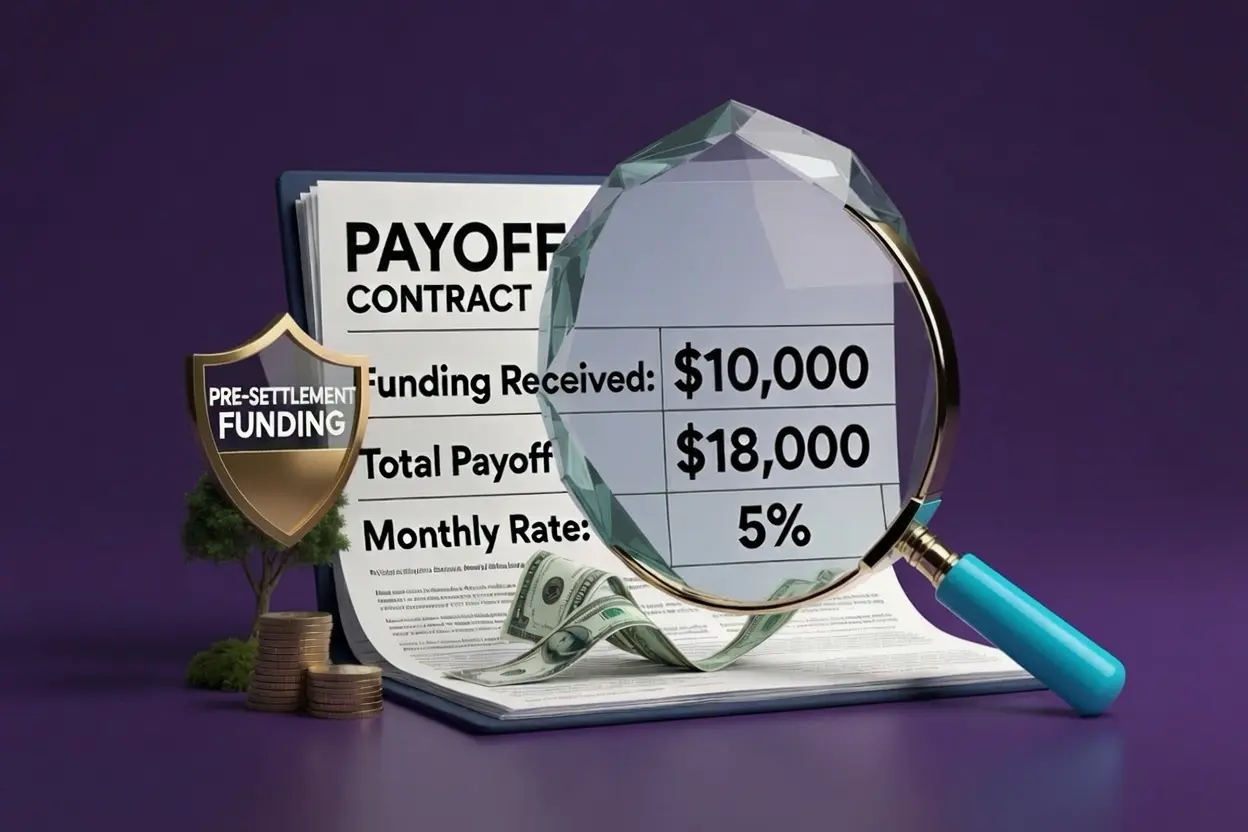
Pre‑settlement legal funding is a non‑recourse cash advance given to a plaintiff while their lawsuit is still pending.
“Non‑recourse” means repayment is tied to the case outcome. If your case results in a settlement or award, repayment comes from those proceeds. If there is no recovery, you do not repay.
If you’re waiting on a case, you already know the hard part isn’t just the legal fight. It’s the time. And time gets expensive. Pre-settlement legal funding is one option injured plaintiffs use to cover bills while their attorney works toward resolution.
Key Takeaways
- Pre‑settlement funding is not a traditional loan. It’s a non‑recourse advance based on your future settlement.
- Approval is based on case strength, not employment, credit score, or income.
- The biggest “cost driver” is usually time. The longer a case takes, the more the payoff can grow.
- The safest way to use it is to take only what you need, and understand the payoff before signing.
Pre‑Settlement Legal Funding, Lawsuit Funding, and “Lawsuit Loans”
You’ll hear a few different terms used for the same general idea:
- pre‑settlement funding
- lawsuit funding
- lawsuit cash advance
- “lawsuit loan” (common term, but not technically accurate)
Whatever name you use, the basic idea is the same. You’re accessing money now based on a portion of what your case may recover later. It’s designed for plaintiffs who have real expenses and can’t wait months (or years) for the case to resolve.
How Pre‑Settlement Legal Funding Works
Most funding follows a simple flow:
- You apply with basic details about your case.
- The funding company contacts your attorney to confirm representation and request case information.
- The company reviews the case to evaluate risk and potential recovery.
- If approved, you receive funds.
- If the case resolves successfully, repayment happens from the settlement distribution.
The connection here is important: funding is built around the case itself, so your attorney’s involvement is part of how the process works.
What “Non‑Recourse” Really Means
Non‑recourse is the feature that makes lawsuit funding different from normal debt.
With traditional debt, repayment is your responsibility no matter what happens. With non‑recourse funding, repayment is contingent on recovering money from your lawsuit.
A simple way to think about it:
- Win/settle → repayment comes from the proceeds
- No financial compensation → no repayment obligation
That’s why legal funding companies strictly focus on case strength. They’re taking on risk that traditional lenders don’t.
Is Pre‑Settlement Legal Funding a Traditional Loan?
Not in the way most people think of a loan.
Traditional loans usually involve:
- credit checks
- income verification
- monthly payments
- personal liability if you can’t repay
Pre‑settlement legal funding is different because:
- there are no monthly payments while the case is pending
- approval is based on case merits, not your credit score
- repayment is connected to a successful recovery, not your paycheck
This is also why the cost structure works differently than bank lending.
For a more personal look at how pre-settlement funding can help you during your case, see What Is Pre-Settlement Funding and How Can It Help You?
Who Typically Qualifies?
Pre-settlement legal funding is limited to plaintiffs who are represented by an attorney. That’s because repayment (if any) is handled through the settlement distribution process.
Approval commonly depends on:
- Liability: is fault reasonably clear?
- Insurance coverage: is there coverage to pay a settlement?
- Injuries and treatment: do medical records support the injury claim?
- Case posture: is the case moving, or stalled?
- Existing liens/prior funding: what else will be paid out of proceeds?
Even strong cases can get denied if the economics don’t work. For example, if policy limits are low and liens are high, there may not be enough net recovery to support an advance.
You might like: Who Qualifies for Pre-Settlement Funds?
What Types of Cases Can Be Funded?
Pre‑settlement legal funding is most common in personal injury cases where a settlement (or jury verdict) is realistic.
Examples often include:
- car and truck accidents
- slip and fall and premises liability
- medical malpractice
- wrongful death
- civil rights and wrongful imprisonment (case‑dependent)
Every case is different, and not every claim qualifies. **Availability can vary by state.
How Much Money Can You Get?
Most funding companies limit advances to a portion of the expected monetary recovery.
That’s not just a “company rule.” It’s also consumer protection. Over‑funding can eat into your net settlement.
Net recovery = what’s left after attorney fees, case costs, medical liens, and other obligations are paid.
A responsible advance is mostly sized to up to 10% of the potential proceeds, so you’re not cornered later.
On Baker Street’s plaintiff funding, for instance, we provide up to about 10% of the estimated settlement value, depending on the case. That “depending” part is important because liens, prior advances, insurance limits, and case risk change the math.
Tip: Avoid taking more than you truly need. The more you take, the more you reduce your net proceeds if the case resolves successfully.
What Can Pre‑Settlement Funds Be Used For?
Most plaintiffs use legal funding for normal life expenses, like:
- rent or mortgage
- utilities
- car payments
- groceries
- medical bills not covered by liens or insurance
- keeping up during time off work
The real benefit is the breathing room it provides. When you’re under financial stress, it’s easy to feel pressured into accepting a quick settlement that might be less than you deserve. Funding can reduce that pressure.
How Much Does Pre‑Settlement Legal Funding Cost?
Costs vary by company, your state, and specifics of your case. Since legal funding is non‑recourse, the total amount you repay is determined by:
- The amount advanced and the terms in the funding agreement.
- How long the case remains open.
- The risk that the case may not recover.
Common pricing models you’ll see
- Simple fee / simple rate: grows in a straight line over time.
- Compounding: grows faster over time because fees stack on fees.
- Caps: limits on how high repayment can go after a set period.
If you’re comparing offers, don’t concentrate only on the “rate.” In your contract, make sure you look for the payoff amount.
You can always ask your funder:
- “What do I owe at 6 months? 12 months? 18 months?”
- “Is it simple or compounding?”
- “Is there a cap? When does it apply?”
- “Are there any fees besides the funding cost?”
Bottom line: cost isn’t only “high or low.” It’s time + structure.
You might like: How Much Do Lawsuit Loans Cost?
Will Legal Funding Affect My Settlement Amount?
Funding doesn’t change the legal value of your claim. Insurance companies don’t suddenly pay more because you got an advance.
What it can change is your ability to wait. If you’re not desperate for quick money, you’re less likely to accept a low offer because you need to stop the bleeding.
At the same time, legal funding reduces net proceeds because repayment (if any) comes from your final lawsuit payment. Before you move forward, make sure you’re comfortable with this trade-off.
Does a Funding Company Control My Case?
A reputable company like Baker Street Funding doesn’t control your case strategy, your attorney, or your settlement decisions.
Your attorney remains in charge of the case. The funding company’s role is financial, and the agreement should reflect that separation.
If any company pressures you on legal decisions, that’s a red flag.
Pros and Cons of Pre‑Settlement Legal Funding
Potential benefits
- helps cover essentials during a long case
- reduces pressure to accept an early lowball offer from the insurance
- no upfront fees, and no monthly payments
- approval based on case strength
Potential downsides
- the payoff can grow over time
- it reduces your net settlement proceeds
- stacking multiple advances can get expensive
- not every case qualifies
Most people do best when they use funding as a tool, not a lifestyle bridge.
How to Choose a Pre‑Settlement Funding Company
Before you sign anything, look for:
- clear, written disclosures
- a payoff amount you can understand in your contract
- attorney involvement and acknowledgment
- no surprise add‑on fees
- a contract that states the non‑recourse nature clearly
- responsive support that answers questions right away
If the agreement feels confusing, slow down. A good funder would rather explain it than rush you.
How Baker Street Funding Works With Plaintiffs and Attorneys
Baker Street Funding provides non‑recourse pre‑settlement legal funding for plaintiffs with active claims.
Here’s what that means:
- Baker Street evaluates your case value and strength, not your financial history.
- Our review process runs through your attorney, since the case file and status are key for funding decisions.
- If approved, we provide a funding agreement that lays out the terms.
- Our funding is sized to avoid overfunding (10% guideline for active claims).
- In most cases, our funding carries a non‑compounding model (case‑dependent).
- Repayment only comes from your settlement or court-ordered compensation.
Frequently Asked Questions
What is pre‑settlement legal funding?
It’s money you can access while your lawsuit is pending, based on the settlement of what your case may recover later.
Do I have to repay if I lose my case?
Pre‑settlement funding is non‑recourse, meaning repayment is required only if there is a successful recovery. Always confirm the definition of “recovery” in your contract.
Can I get pre‑settlement funding without an attorney?
No. Attorney involvement is strictly required because the funder needs case documentation and repayment (if any) is handled through settlement distribution.
How fast can I get funded?
Timing depends on how quickly your attorney provides case file. Many decisions happen within 1-2 days once your attorney sends the documents.
Will this show up on my credit report?
Pre‑settlement funding isn’t underwritten like consumer credit because it’s based on case merit, not your credit profile.
How much should I take?
Most injured clients do best when they take only what they need to cover essentials. Smaller advances usually mean lower payoff later.
Can I pay it off early?
Baker Street Funding allows early payoff, with no prepayment penalties.
What should I ask before signing?
Ask for the exact payment amount at multiple time points and confirm whether fees are simple or compounding, and whether a cap applies.