The accident itself was just the beginning. The real battle often starts in the weeks and months that follow. Medical bills start arriving. Your savings dwindles. And the pressure mounts — you can’t work, but the rent is still due, the car payment won’t wait, and you have a family to feed. All the while, your personal injury case is moving at a snail’s pace.
It’s a stressful, frustrating position to be in — and the insurance company knows it. They know that the longer you wait, the more desperate you might become, and the more likely you are to accept a lowball settlement offer that’s a fraction of what you truly deserve.
But what if you could eliminate that financial pressure? What if you could access a portion of your future settlement funds right now, with zero risk if your case doesn’t win?
This is exactly what pre-settlement funding is designed for. This guide explains what it is, how the process works, what it realistically costs, and most importantly — whether it’s the right tool for your situation.
What Is Pre-Settlement Funding?
Pre-settlement funding is a non-recourse cash advance made to a plaintiff while their personal injury lawsuit is still pending. Unlike a bank loan, it is not based on your credit score or income — it’s based on the strength of your legal case.
The key word is non-recourse: if your case does not result in a settlement or verdict in your favor, you owe nothing back. Repayment only happens if you win, and it comes directly out of your settlement proceeds. Your attorney handles the payoff so you don’t have to think about it.
For a comprehensive explanation of how pre-settlement legal funding works from a legal and technical standpoint, see our full guide: What Is Pre-Settlement Legal Funding?
How Is Pre-Settlement Funding Different from a Loan?
Most people hear “funding” and assume there’s a monthly payment involved. There isn’t. Here’s how pre-settlement funding compares to a traditional loan:
| Traditional Bank Loan | Pre-Settlement Funding | |
|---|---|---|
| Approval based on | Credit score, income, job history | Strength of your legal case |
| Monthly payments | Yes | No |
| Personal liability if you lose | Yes | No |
| Credit check required | Yes | No |
| Repayment source | Your paycheck | Your settlement proceeds only |
Because the funding company takes on the risk that your case might not recover, this product works very differently from conventional debt — and it costs more than a bank loan for that same reason.
How Does the Pre-Settlement Funding Process Work?
The process is straightforward and moves quickly once your attorney is involved.
Step 1: Apply. You complete a short application — online or by phone — with basic information about yourself and your case. No credit checks. No bank statements. No upfront fees.
Step 2: Your attorney is contacted. With your permission, the funding company reaches out to your attorney to review key details: how the accident happened, the extent of your injuries, available insurance coverage, and the likely value of your claim.
Step 3: Approval and agreement. If your case qualifies, you receive a written funding agreement that clearly states the advance amount and all terms. Review this carefully with your attorney before signing — a reputable company will encourage you to take your time. For a detailed breakdown of what to look for in a funding agreement, see What Is a Settlement Loan and How Does It Work?.
Step 4: You receive your money. After signing, funds are sent directly to you — typically via direct deposit or overnight check — often within 24 hours.
Step 5: Repayment happens automatically at settlement. When your case resolves, your attorney pays the advance (plus agreed charges) directly from the settlement funds before sending you the remaining balance. If your case doesn’t result in a recovery, you owe nothing.
Who Qualifies for Pre-Settlement Funding?
Eligibility is based on your case — not your financial history.
Generally, you need:
- An active personal injury claim where another party’s negligence caused your injuries
- A contingency-fee attorney representing you
- A case with a minimum expected value (at Baker Street Funding, the threshold is typically $50,000)
- Clear liability and documented injuries
- An insured defendant with sufficient coverage to support a recovery
Common case types that qualify include: car, truck, and motorcycle accidents; slip and fall and premises liability; medical malpractice; wrongful death; product liability; and certain workplace accidents. See all case types we fund.
You do not need good credit, a job, or any current income. If another driver ran a red light and put you in the hospital for three months, you are likely a strong candidate regardless of your financial situation.
What Can You Actually Use Pre-Settlement Funding For?
Most plaintiffs use the advance to cover essential living expenses they cannot meet while they’re out of work and waiting on their case:
- Rent or mortgage payments — keeping a roof over your head
- Car payments — protecting your vehicle from repossession
- Groceries and daily living costs — keeping your household running
- Medical co-pays or treatment costs — getting the care your case requires
- Utility bills — preventing shutoffs during a difficult stretch
- Replacing lost income — bridging the gap if you cannot return to work
The point is not to fund a lifestyle change. The point is to remove the financial desperation that can force you to take a bad settlement. Take only what you genuinely need for essential expenses — the rest of your settlement should stay in your pocket.
You might like: How to Responsibly Use Your Pre-Settlement Funds
How Pre-Settlement Funding Levels the Playing Field
Insurance companies are not in the business of paying fair settlements quickly. Their adjusters are trained to use delay as a strategy. The longer your case drags on, the more financial pressure builds on your side — and the more tempting it becomes to accept whatever they put on the table just to make the stress stop.
Pre-settlement funding changes that equation. When your essential bills are covered, you don’t need to settle for less. Your attorney gains the breathing room to investigate, negotiate, and litigate properly. You can say no to a lowball offer without your electricity getting shut off the next week.
That leverage — the ability to wait — is often the difference between a rushed, inadequate settlement and one that reflects the true value of your case.
What Does Pre-Settlement Funding Cost?
Costs vary by company, by state, and by the specifics of your case.
At Baker Street Funding specifically:
| Benefit | |
|---|---|
| Rate | Non-compounding, starting at 2.95% per month (on most cases) |
| Cap | 2–3 year cap — repayment stops growing after this period |
| Upfront fees | None |
| Monthly payments | None while case is pending |
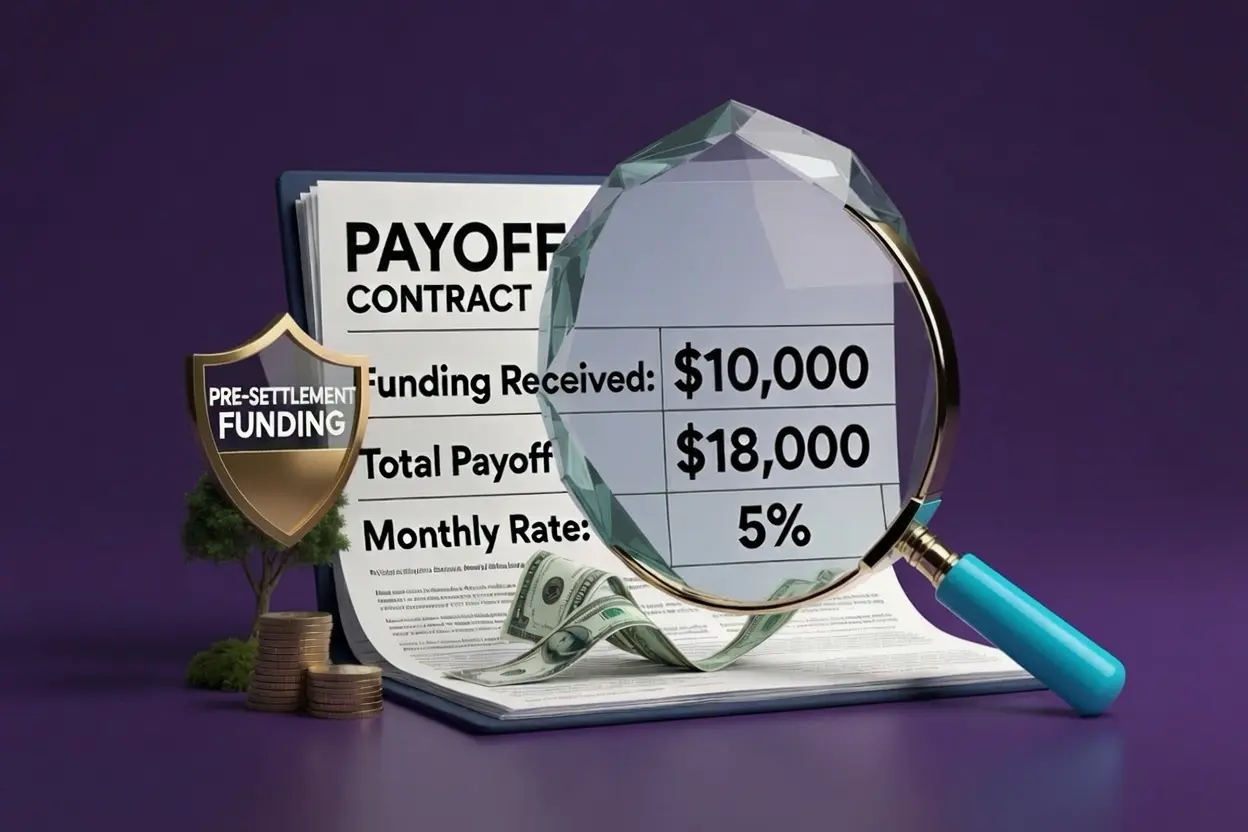
Why time matters most. Because legal funding is non-recourse and cases can take one to three years, pricing reflects the time risk. A non-compounding rate means your cost grows in a straight line — not exponentially. A cap means you’re protected if the case takes longer than expected.
What you should always ask before signing:
- “What do I owe if my case settles in 6 months? 12 months? 18 months?” — get a dollar amount, not just a percentage.
- “Is the rate simple or compounding?”
- “Is there a repayment cap?”
- “Are there any fees beyond the funding cost?”
If a company can’t or won’t give you a clear dollar payoff at multiple time points, that’s a red flag. Use our Lawsuit Loan Calculator to estimate costs.
Should You Get Pre-Settlement Funding? What to Weigh Before You Decide
If your case has real value but you’re three months behind on rent, the calculus is usually straightforward — the leverage funding buys your attorney may be worth more than the cost of the advance. If your case is small and the cost of funding would eat a significant share of the recovery, the math may not work in your favor. The right answer depends on your specific situation, not a one-size-fits-all rule.
Is Pre-Settlement Funding Right for You?
Pre-settlement funding makes the most sense when the financial need is real and the expense is essential. If you’re struggling to keep your household running while your case works its way through the legal system, funding can be the tool that lets you and your attorney fight for what your case is genuinely worth — instead of settling fast because you’re out of options.
It makes less sense for non-essential spending, or when the expected recovery is too small relative to the cost of funding.
If you’re dealing with real financial pressure while waiting for your personal injury case to resolve, you don’t have to go through it alone.
Contact Baker Street Funding today for a free, no-obligation consultation at (888) 711-3599. Our specialists will review your case, answer your questions honestly, and let you know what you qualify for — with no pressure and no commitment.
Frequently Asked Questions
Is pre-settlement funding the same as a lawsuit loan?
They refer to the same general product. “Lawsuit loan,” “pre-settlement funding,” “legal funding,” and “lawsuit cash advance” are commonly used interchangeably. The more accurate term is pre-settlement funding, since it’s non-recourse — not a traditional loan.
My bills are piling up and I can’t wait. How quickly can I actually have money in my account?
Our process is designed to provide quick relief for urgent needs. Upon approval, funds are typically disbursed within 24 hours to help you cover your immediate expenses. We understand that time is of the essence and we work tirelessly to ensure our clients have access to the funds they need when they need them.
Will pre-settlement funding affect my credit score?
No. Pre-settlement funding is not underwritten like consumer credit and typically does not appear on or affect your credit report.
My attorney said to be careful about funding. What should I watch out for?
The main things to watch for are compounding rates, which grow exponentially the longer your case takes, and agreements with no repayment cap, which leave you exposed if the case drags on for two or three years.
You should also ask whether there are any fees beyond the stated funding cost, and always request a written payoff estimate in dollar amounts — not just a percentage — at 6, 12, and 18 months. A reputable company will provide all of this without hesitation and will actively encourage your attorney to review the agreement before you sign.
If a funder pressures you to move quickly or resists attorney involvement, walk away. Baker Street Funding works directly with your attorney as part of the process, not around them.
I only need a few hundred dollars for one bill. Is pre-settlement funding still worth it for a small amount?
For very small, one-time amounts, funding may not be the right fit. Most companies have minimum advance thresholds, and the process requires your attorney’s involvement regardless of the amount. If your need is truly minimal, consider exploring a payment plan with the creditor first.
If you need ongoing help covering several months of essential expenses while your case moves forward, even a modest advance can make sense. The best first step is an honest conversation with a funding specialist about your specific situation.
What if my case takes longer than expected?
This is why asking for payoff amounts at multiple time intervals — 6, 12, and 18 months — is critical before signing. A non-compounding rate with a cap protects you if the case stretches. Without a cap, costs can compound significantly over a long case.
I’m worried about accepting a low settlement just to pay rent. Can funding really help me hold out for more?
This is exactly the situation pre-settlement funding is designed for. Insurance adjusters are trained to delay, knowing financial pressure eventually pushes plaintiffs to accept whatever is on the table. When your essential bills are covered, that pressure disappears. Your attorney can negotiate from a position of patience, reject low offers, and take the time to build the strongest possible claim.
Funding doesn’t change the legal value of your case — it changes your ability to wait for what it’s actually worth.
Can I use the funds for anything?
There are no restrictions on how you use the funding. In practice, most plaintiffs use it for essential living expenses: rent, utilities, groceries, car payments, and medical costs.