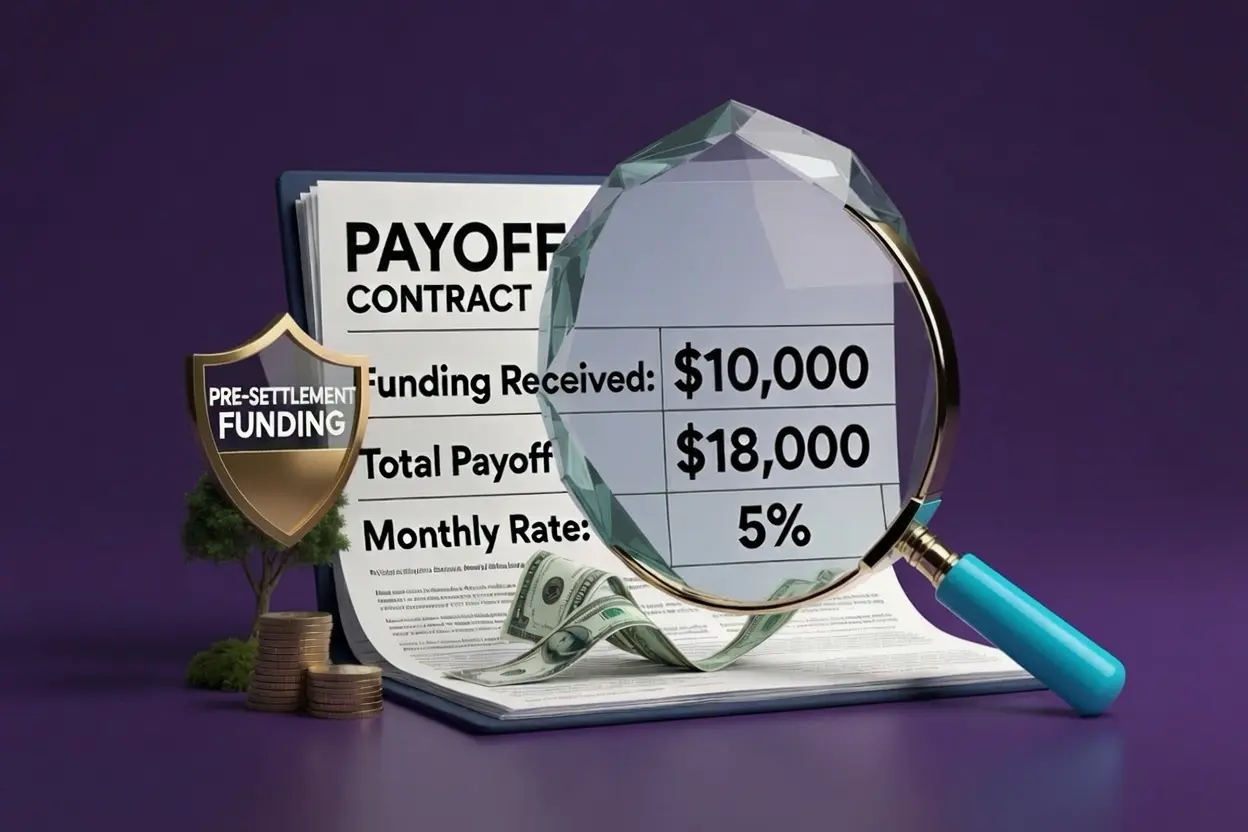
Pre-settlement funding, also known as lawsuit financing or litigation funding, can give you important financial support while your case is ongoing. Basically, your funder’s hands you a lump sum of cash in exchange for a share of your expected settlement or award.
The good news? If don’t win, you owe nothing. But, if you do, you’ll need to repay the advance plus interest. The catch? The repayment amount depends on your agreement with the lawsuit funding company.
Before diving in, make sure you understand the funding agreement and how it might affect your final settlement. Will the remaining amount be enough to cover your expenses and any damages?
Here are some questions to ask before committing to pre-settlement legal funding.
Key Factors to Consider When Evaluating Your Pre-Settlement Funding Offer
What is the total annual cost (APR)
If you’re considering pre-settlement funding, remember that it comes with fees and rates that are higher than what a bank would charge. The main cost to consider is the APR, which can vary widely, ranging from 36% to 60% or more based on the company you choose.
The APR (Annual Percentage Rate) is the total cost of your funding over one year, including interest and fees.
Importantly, pre-settlement funding fees aren’t always bad as long as your funding agreement has with a lower APR, than one without a fee but higher overall costs.
How is the Interest Rate Calculated?
1. Simple Interest
Simple interest is calculated solely on the principal amount you take out. For instance, if you borrow $10,000 at a simple interest rate of 36% for one year, the total annual interest would amount to $3,600.
Whenever possible, consider agreements with simple interest. This not only keeps your repayment predictable but can also help lower the overall cost.
2. Compound Interest
Legal funding with compound interest works like this: it’s calculated not only on your initial funding amount but also on the interest that builds up over time. This means that the longer you hold a contract, the more you’ll pay.
3. Tiered Interest
Tiered interest rates on settlement advances offer lower rates for the initial borrowed amount, which may then triple up as you reach certain thresholds or if your case doesn’t settle within a year. For example, your initial $5,000 may be subject to a 30% interest rate in the first year. However, if your case reaches a settlement in a year and a half, the interest could rise to 80% in the second year.
This structure can be good if you only need a small one-time amount initially and you’re absolutely sure that your case will settle in less than a year.
What are the Repayment Terms?
When you receive pre-settlement funding, you’re essentially obtaining a non-recourse advance, and it comes with repayment terms. Once you receive your compensation, your attorney will handle the repayment according to the contract.
- Look for Caps. A cap only racks up interest for a limited time. For example, if your legal funding agreement includes a two-year cap, you will incur charges for only two years, regardless of whether your case takes four years to resolve.
- Examine the Repayment Timeline. Review the specifics regarding when repayment is due. Some funding companies will give your attorney 3 days to repay once the receive the settlement check is is in, while others offer a longer 14-day period.
- Identify Penalties for Delayed Repayment. Some agreements may include penalties for late payments.
- Understand Partial Payment. See if the contract offers partial payment, if you receive a lower settlement. Try negotiating terms that allow for a smaller payment.
- Prepayment Penalties. Confirm if there are any penalties for paying off the funding early if you decide to pay the advance back before your case settles.
Is Additional Funding Available?
The amount you can get approved from your personal injury lawsuit really depends on your funder’s agreement, as well as the risks and value of your case. Typically, legal funding companies may provide around 10% of your case’s value. And some offer multiple loan options, while others don’t.
When you’re reviewing your contract, keep an eye out for any clauses that talk about future funding or extra advances. You might find this info under headings like “Additional Funding Options,” “Supplemental Advances,” or “Subsequent Loans.”
Also, pay close attention to any requirements for qualifying for extra funding, like case value assessments, progress, and how your repayment might add up. If anything isn’t clear, feel free to reach out to the funding company directly.
What Happens if You Lose Your Lawsuit?
Don’t be afraid to ask the legal funding firm what happens if you don’t receive a settlement. Will you still be responsible for repayment?
Fortunately, about 99.9% of pre-settlement funding companies offer non-recourse loans, meaning you won’t have to repay if your case isn’t successful. Just make sure you understand the details. You definitely don’t want to end up in a situation where you owe money to the funding company, no matter what happens with your settlement.
Is This a Trustworthy Legal Funding Company?
Not all pre-settlement funding companies are created equal, so it’s important to do your due diligence before signing an agreement. Take some time to look into the company’s background, including its reputation, experience, and customer service. Remember, you’re not alone in this process, and finding the right funder can really make a difference in your journey.
Legitimate pre-settlement legal funding companies, like Baker Street Funding, comply with all regulations. And even when there’s no regulation in a state, our advances adhere to the highest quality standards.
What You Can Do to Get a Fair Funding Offer
- Discuss with your attorney how the legal funding contract works.
- Learn how interest rates work.
- Make sure your funding is risk-free.
- Never sign a contract unless you fully understand it.
- Don’t settle for the first funding company you come across.
- Read reviews and testimonials.
- Keep lines of communication open with your funder throughout the process.
When You Shouldn’t Sign a Pre-Settlement Funding Agreement?
Here are some red flags:
- Did the pre-settlement funding company forget to reach out to your attorney?
- Watch out for hidden costs and sneaky markups.
- Surprised by a completely different interest rate on the contract compared to what they promised over the phone?
- They might pressure you to secure the highest amount possible.
- Are you missing out on the full funding contract?
- Beware of late-night phone calls, threats, or high-pressure tactics to get you to sign.
The Takeaway
If you’re having a difficult time covering expenses while waiting for your lawsuit to wrap up, pre-settlement funding can be a lifeline. Just be sure to look over the terms and conditions before you sign anything. Keep in mind that choosing the right pre-settlement funding agreement will ultimately depend on the funding provider you go with. Finding a reputable legal funding company could be a smart move for your case.
Consider Baker Street Funding, for instance. All our legal funding contracts are non-recourse, meaning there are no credit or income checks, and there is no payment until you get compensated for your damages.
With us, you’ll always know the exact cost of your pre-settlement funds before accepting to sign it. Our rates vary from 2.95% – 3.4% per month, simple (in most cases). Plus, we cap all funding after 3 years from when the last funding contract was executed. This means you’ll pay the same rate.
Baker Street Funding is committed to helping personal injury victims make sound funding decisions. Apply for a lawsuit loan today.
FAQ
Does applying for a pre-settlement loan hurt your credit?
No. Our lawsuit loans are not reported to credit bureaus and do not require a credit check. It does not affect your credit score in any way.
Can you apply for funding without a job?
Yes. Baker Street Funding doesn’t require a job or even income verification. Our advances are based solely on the merits of the case.
What’s the processing time for a pre-settlement funding evaluation?
While some funding companies can take weeks to get back to you, Baker Street Funding makes legal funding decisions in just 48 hours, as long as your lawyer gives us everything we need.
However, we do need your attorney’s cooperation for pre-settlement funding. So, if your lawyer takes a while to respond, it doesn’t matter how fast our underwriters are—it’ll still take weeks to get that decision.