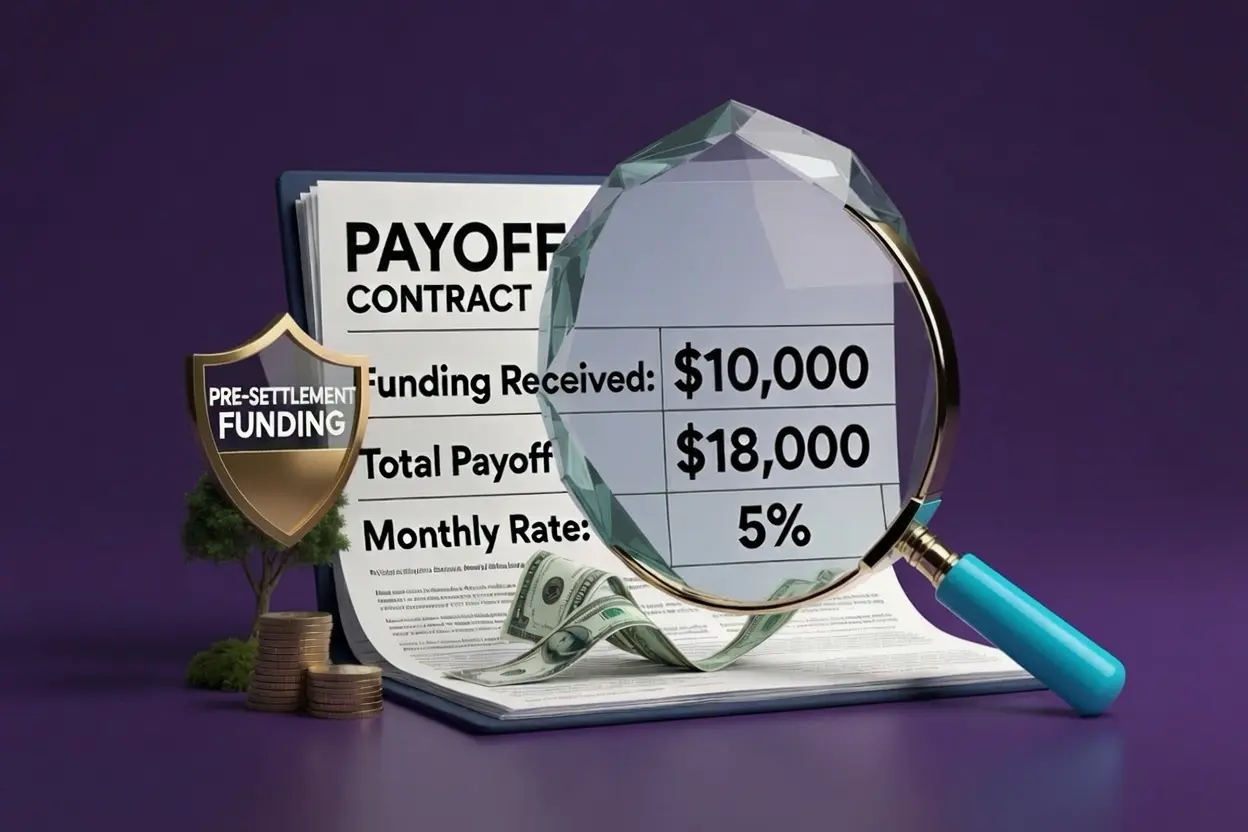
When you compare pre-settlement funding offers, the rate on the page is only part of the story.
Two companies can both advertise “3% per month” and still leave you with very different payoff amounts. The difference usually comes down to how the contract calculates interest, whether fees are added, and whether the agreement includes a cap.
That is why one of the first questions you should ask is simple:
Is the contract using simple interest or compound interest?
The short answer
- Simple interest means the charge is based only on the amount advanced.
- Compound interest means interest is added to the balance, and future interest is charged on that larger balance.
The longer your case takes, the more that difference matters.
Why this matters in pre-settlement funding
Pre-settlement funding is commonly called a lawsuit loan, but it works differently from a traditional bank loan.
You do not make monthly payments while your case is pending. Repayment comes from your settlement or award. If there is no recovery, there is no repayment.
That protects you from out-of-pocket debt. But if your case does recover, the contract still affects how much of your money you keep. So the way interest is structured matters.
You might like: What’s the Average Rate for Settlement Loans?
What simple interest means
With simple interest, the rate is charged on the original amount advanced.
Here is a basic example using a $10,000 advance at 3% simple monthly interest:
- After 6 months, the payoff is $11,800
- After 12 months, the payoff is $13,600
- After 24 months, the payoff is $17,200
The math stays predictable because the charge is tied to the original advance, not to previously added interest.
What compound interest means
With compound interest, interest is added to the balance and the next round of interest is charged on that higher amount.
Using the same $10,000 example at 3% compounded monthly:
- After 6 months, the payoff is about $11,941
- After 12 months, the payoff is about $14,258
- After 24 months, the payoff is about $20,328
That is the key difference. Compound interest may not look dramatically different on day one, but it grows faster over time. If your case takes longer than expected, the gap can become expensive.
Is simple interest always better?
Usually, simple or non-compounding interest is easier to understand and easier to predict.
But “simple” does not automatically mean “cheap.”
A simple-interest contract can still cost more if:
- the monthly rate is high
- the company adds fees
- the agreement has a long minimum term
- you take multiple advances
- there is no cap on how long charges can grow
So do not stop at the label. Compare the total payoff, not just the rate name.
Rate caps matter too
A rate cap limits how long charges continue to accrue.
That is important because lawsuits do not always move on your timeline. Negotiations can drag on. Treatment can continue. Trials can get delayed. Appeals can slow down payment.
A capped agreement gives you a ceiling. Without one, even a reasonable-looking rate can keep growing longer than you expected.
Fees can affect the total cost, but they are only part of the picture
Interest is not the only number that matters. Fees can increase the total payoff, but a contract with fees is not automatically more expensive than a no-fee contract.
In some cases, an offer with a fee may still cost less overall if it has:
- a lower rate
- simple interest instead of compound interest
- a shorter accrual cap
- lower total payoff over time
That is why you should compare the full payoff, not just whether fees are present.
Before you sign, ask for:
- the interest type
- the monthly rate
- any itemized fees
- the total payoff at 6, 12, 18, 24, and 36 months
- the maximum accrual period or cap
A “no-fee” contract can still cost more if the rate is higher or the balance grows longer.
If a company will not show you the payoff schedule in writing, slow down.
Make sure to ask for an itemized breakdown of all charges and a written payoff schedule in your pre-settlement funding agreement.
You might also like: How Much Lawsuit Loans Cost
The bottom line
The best pre-settlement funding agreement is not the one with the lowest advertised number. It is the one you can clearly understand.
You should know:
- how pre-settlement funding interest rates work
- whether charges compound
- whether fees are added
- whether there is a cap
- what the total payoff looks like over time
That is how you protect more of your recovery while still getting the financial breathing room you need now.
Need pre-settlement funding but want to protect more of your settlement?
Talk with Baker Street Funding to review transparent terms, clear payoff expectations, and competitive interest rates designed to make costs easier to understand.
FAQ
Is pre-settlement funding the same as a traditional loan?
No. It is often called a lawsuit loan, but it is structured differently. There are no monthly payments while the case is pending, and repayment is tied to the case outcome.
Why can two offers with the same rate cost different amounts?
Because the contract may use simple interest, compound interest, tiered pricing, different fees, or different cap terms.
Should you borrow the maximum amount you qualify for?
Usually, borrowing only what you need puts you in a better position to protect more of your settlement later.