You don’t “collect” pre-settlement funding the way you’d collect Social Security or an insurance benefit. In most cases, it’s a single lump-sum deposit — not a recurring payment. Funds typically hit your account in 24 to 48 hours after your contract is signed — sometimes within hours. For larger cases, we can also structure scheduled monthly advances (for example, $3,000/month for 6 months) under the same non-recourse terms.
The full timeline from your first phone call to cash in hand usually runs 1 to 5 business days, and the biggest variable is how quickly your attorney sends over your case file.
Here’s what the timeline actually looks like, what controls how fast it moves, and when you can apply for more if your case drags on.
Why people think they have to “collect” it (and why they don’t)
The word “collecting” comes from how plaintiffs are used to thinking about money during a lawsuit — disability checks, workers’ comp benefits, structured settlement payouts. Those are collected over time, in installments.
Pre-settlement funding is different. At Baker Street Funding, your approved amount — anywhere from $1,500 to $2,500,000, customized up to roughly 10% of your estimated settlement value — is wired or sent by check in one transaction. There’s no second check, no monthly payment, nothing to follow up on. You get it once (or as recurring advances on a monthly basis), you use it as needed, and repayment only happens at the end — and only if you win. That’s the standard mental model for most plaintiffs: one lump sum in, one lump sum out (from the settlement, not your pocket).
For high-value cases — typically settlements estimated at $250,000+ — we can also write a scheduled-disbursement contract that delivers funds in monthly installments (commonly $2,000–$5,000/month over 3–12 months). It’s the same non-recourse agreement, the same 2.95% to 3.4% rate on disbursed funds, the same “no win, no repayment” protection — the only difference is the payment schedule. This works well for plaintiffs who want budgeting discipline or who’d rather not have a large balance accruing fees from day one.
The full timeline: from application to deposit
Here is the actual sequence, step by step, with realistic timing for each stage:
Step 1 — You apply (5 minutes). Online form or a phone call. Basic information: your contact details, your attorney’s name and number, the type of case, and the date of injury. No credit check. No income verification. No tax returns.
Related: How to apply for a lawsuit loan →
Step 2 — We contact your attorney (same day, usually within hours). Your attorney’s cooperation is the single biggest variable in how quickly funds reach you. We request the case file: complaint or demand letter, police report, medical records, insurance information, and any settlement correspondence.
Step 3 — Underwriting (a few hours to 1 business day after the case file arrives). Our underwriters evaluate liability, damages, available insurance, and venue. Because we don’t pull credit or verify employment, this stage is faster than any traditional loan. If your case is straightforward, you’ll often have a decision the same day.
Step 4 — Contract issued and reviewed (same day). If approved, you receive a written contract showing the advance amount, the 2.95% to 3.4% non-compounding monthly rate, the 2 or 3-year cap on accrued fees, and the repayment terms. Your attorney reviews it with you.
Read more about Our rates →
Step 5 — Funds disbursed (hours after the contract is signed). Once you and your attorney sign, funds are sent by ACH wire or overnight check. Wire transfers typically post the same business day; checks arrive next-business-day.
The whole sequence — application to deposit — usually completes in 24 to 48 hours from the moment your attorney provides the case file. When the file lands fast, plaintiffs have been funded the same day.
When in your lawsuit can you actually apply?
You don’t have to wait for any specific milestone. The two non-negotiables are:
- You’re represented by an attorney on contingency. If you don’t have one yet, that’s the first step. We can’t fund a case without counsel because the attorney is the one who eventually disburses repayment from the settlement. [More on why → /lawsuit-loans-without-an-attorney/]
- Your attorney has enough documentation for us to underwrite the case. This usually means a police report or incident report, medical records showing the injury, and clear liability against an insured defendant.
You can apply days after the accident in some cases, as long as your attorney already has the basic file. You don’t need a filed complaint, a deposition, or an offer on the table — though those things, when they exist, often increase the amount we can advance.
What can slow your funding down?
In our experience, the timeline only slips for a handful of reasons:
- Attorney’s office is slow to respond. This is the most common cause of delay. If your attorney is in trial or your case is with a paralegal who’s out of office, the file can sit. A quick text to your attorney’s office asking them to send the file usually solves this.
- Banking holidays or weekend timing. A contract signed Friday at 4 p.m. won’t fund until Monday. Wires don’t run on weekends.
- Incomplete medical records. If you’re still treating and your attorney hasn’t gathered records yet, underwriting may need to wait. For active treatment cases, we can sometimes underwrite on partial records.
- Complex liability or coverage questions. Multi-defendant cases, low policy limits, or disputed liability take longer to evaluate.
When does interest start accruing?
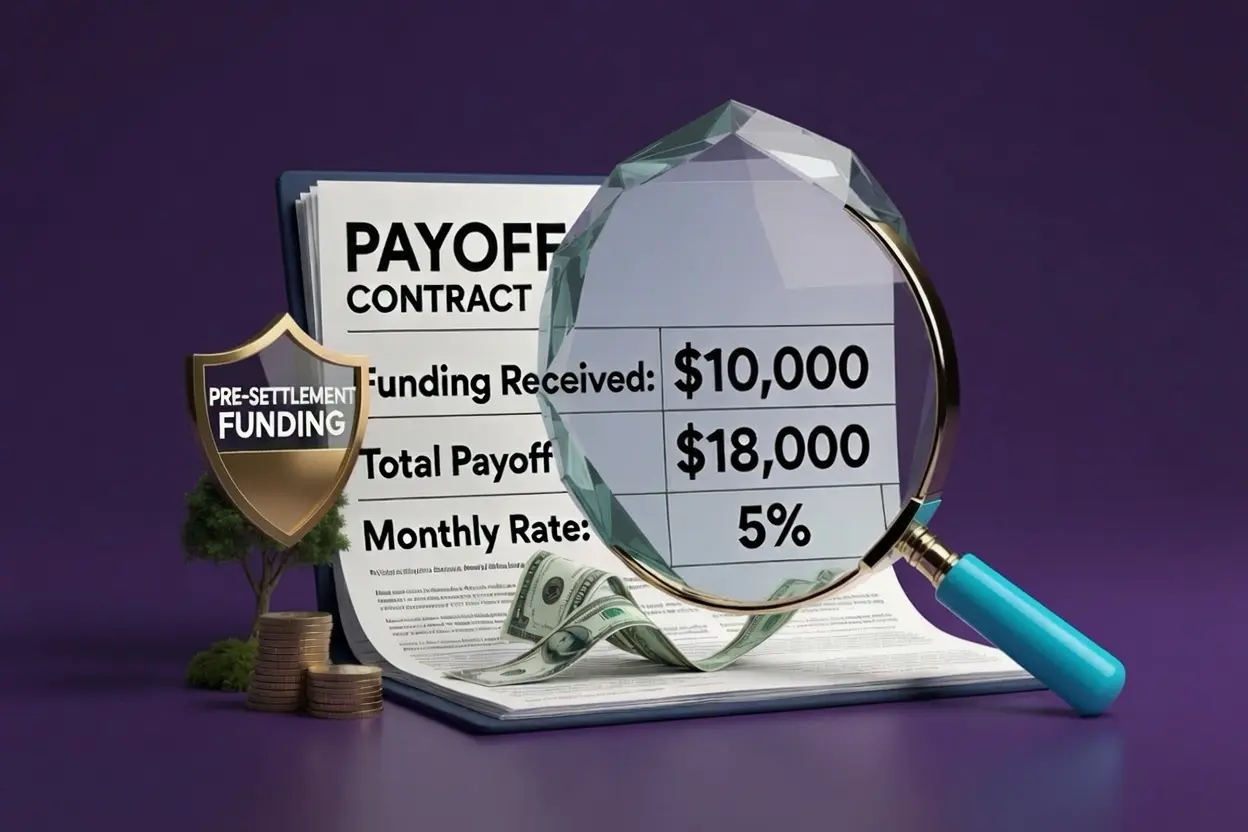
Interest begins accruing the day the funds are disbursed — not the day you apply, not the day you’re approved. Our rate is 2.95% per month, non-compounding (simple interest), which means each month adds the same dollar amount to your balance — it doesn’t pile interest on top of interest. We also cap accrued interest at either 2 or 3 years (depending on your case), so even if your case takes longer, you stop accruing fees at month 24 or 36. That’s deliberately patient — most funding agreements from other companies either compound monthly or have no cap, both of which can dramatically inflate repayment on a multi-year case.
Related: How interest works →
When can you apply for additional funding?
Most plaintiffs ask for one round of funding and never need another. But personal injury cases take roughly 18 months on average to resolve, and longer if they go to trial — bills don’t stop, and a single advance doesn’t always last.
You can apply for a top-up advance any time after your initial funding, as long as your case has progressed (new medical records, new offers, depositions, etc.) and there’s room within roughly 10% of your estimated settlement value.
Related: Supplemental funding details →
If you have funding from another company and they’ve quoted you a high rate or compounding interest, you can also apply for a buyout — we pay them off and put your balance under our 2.95% to 3.4% non-compounding rate.
Related: Buyouts and refinancing →
When does repayment start?
Never, until you settle. There are no monthly payments. When your case resolves, the settlement check goes to your attorney’s trust account (IOLTA), and your attorney sends our payoff directly from the settlement proceeds before disbursing the rest to you. You never write a check to us.
Related: Repayment process in full →
If you don’t win the case, there is no repayment. That’s what “non-recourse” means, and it’s the legal foundation of the entire industry.
Bottom line
You can collect pre-settlement funding on a monthly basis if your case is worth over $250,000 — or you can receive it once, fast. From the moment your attorney sends us a complete case file, expect funds in your account within 24 to 48 hours, often the same day. The fastest way to compress that timeline is to make sure your attorney’s office knows the request is coming so the file moves quickly.
If your case is worth $50,000 or more and you’re represented by counsel, you can apply now → or call (888) 711-3599. Funding decisions are made by our in-house underwriters, terms are disclosed in writing before you sign, and you owe nothing if you don’t win.
Frequently asked questions
How long does it take to get pre-settlement funding?
Most approved plaintiffs receive funds within 24 to 48 hours after their attorney provides the case file. Same-day funding is possible when the file is complete and the contract is signed before mid-afternoon.
Do I get pre-settlement funding in monthly payments?
Usually, no — most plaintiffs receive a single lump-sum deposit. However, for larger cases, Baker Street Funding can structure a scheduled monthly advance (for example, $3,000/month for 6 months) under the same non-recourse terms. Both options qualify as the same pre-settlement funding product, and you can apply for a supplemental advance later in either case.
When does interest start on pre-settlement funding?
Interest accrues from the date funds are disbursed, not from the date of your application. Baker Street Funding charges 2.95% to 3.4% per month, non-compounding, capped at 2 or 3 years, depending on the risk of the case.
Can I get pre-settlement funding the same day I apply?
Yes, in some cases. If your attorney sends the case file quickly and underwriting clears the same day, contracts can be signed and funds wired within hours.
When do I have to start paying back pre-settlement funding?
You don’t make any payments while your case is active. Repayment is taken from your settlement at the end, by your attorney, before they disburse the remainder to you. If you lose your case, you owe nothing.