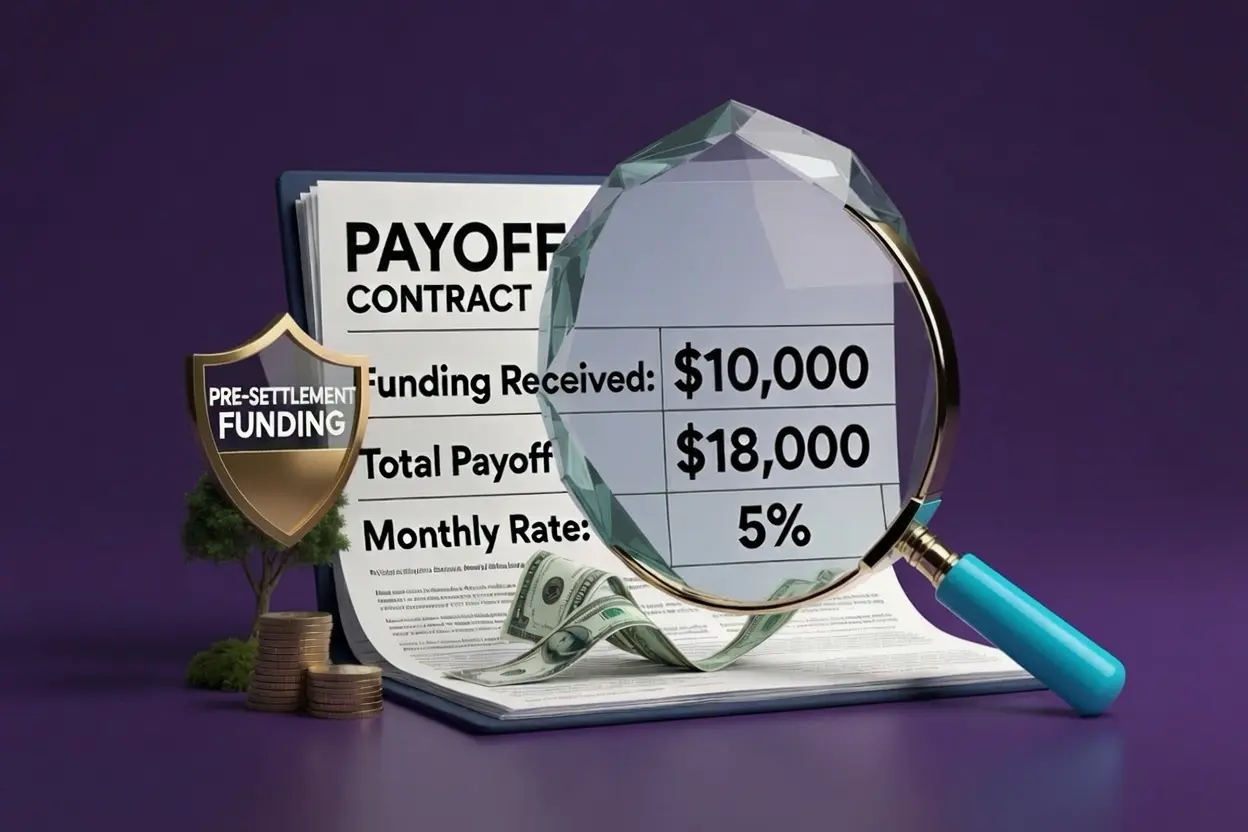
If you were hurt on the job because of someone other than your employer — a property owner, equipment manufacturer, subcontractor, or negligent driver — you may have a third-party work injury lawsuit on top of (or instead of) a workers’ comp claim. These cases pay more, but they also take longer. A work injury lawsuit loan from Baker Street Funding gives you cash now, in 24 to 48 hours, with no payback owed if you lose.
Rates start at 2.95% per month, non-compounding, capped at 3 years. No credit check. No income verification. You only repay if your attorney recovers a settlement or verdict.
💡 Quick clarity: Baker Street Funding primarily funds third-party work injury lawsuits — the personal injury claim filed against a non-employer who caused your accident. We fund workers’ comp claims only in a few specific states. See our workers’ comp funding eligibility.
When You Have a Third-Party Work Injury Lawsuit (Not Just Workers’ Comp)
Workers’ compensation covers you regardless of fault — but it’s also limited. It pays medical bills and a portion of lost wages, and that’s usually it. No pain and suffering. No full wage replacement. No accountability for the party that hurt you.
A third-party work injury claim is different. It’s a personal injury lawsuit filed against someone other than your employer — and it can recover damages that workers’ comp legally cannot. According to the Bureau of Labor Statistics, there were 5,070 fatal work injuries in the U.S. in 2024 and 2.5 million nonfatal cases in private industry. A large share of those injuries involved a third party — a contractor, a vehicle on the job site, a defective product, a property owner — meaning the injured worker had grounds for a separate civil lawsuit.
You may have a third-party claim if any of the following caused or contributed to your injury:
- A negligent driver struck you while you were working (delivery, sales call, commute in a company vehicle, road crew).
- A property owner failed to maintain safe conditions at a site your employer didn’t own.
- A contractor or subcontractor on a shared job site (common on construction projects).
- A manufacturer of defective equipment, machinery, scaffolding, or safety gear.
- A maintenance company that improperly serviced equipment.
- A chemical supplier that didn’t warn about a hazardous substance.
These are the cases we fund. They settle for substantially more than workers’ comp pays — and they take substantially longer to resolve.
How a Work Injury Lawsuit Loan Works
A work injury lawsuit loan — also called pre-settlement funding, a lawsuit cash advance, or non-recourse legal funding — is a cash advance against your future settlement, not a loan in the traditional sense.
Here’s how it works:
- You apply (2 minutes online or by phone — 888-711-3599).
- We contact your attorney for the case file (accident report, medical records, demand letter, defendant insurance info).
- We underwrite the case — not your credit. We look at liability, damages, and the defendant’s ability to pay.
- You sign the contract with your attorney’s acknowledgment.
- Funds are wired the same day, often within hours of contract signing.
The non-recourse part is the most important of all if your case doesn’t win, you owe Baker Street Funding nothing. The risk shifts to us, not you.
You must have an attorney representing you on a contingency basis. If you don’t yet, your case can’t be funded — but here’s how to choose the right lawyer
Related: How pre-settlement funding works
How Much Can You Get From a Work Injury Lawsuit Loan?
Baker Street Funding advances $1,500 to $2,500,000, customized up to roughly 10% of the estimated settlement value. The exact amount depends on:
- Case strength — clear liability vs. shared fault
- Severity of injuries — surgeries, permanent impairment, ongoing treatment
- Defendant insurance coverage — commercial policies usually mean larger advances
- Venue — some jurisdictions historically pay more on similar cases
- Stage of litigation — pre-suit, filed, post-deposition, or post-mediation
- Existing liens — workers’ comp liens, medical liens, child support
A short demand letter and an unfiled claim will support a smaller advance. A filed lawsuit with a mediation date, expert reports, and an MRI showing structural damage will support a much larger one.
Estimate your funding amount with our calculator
Who You Can Sue in a Third-Party Work Injury Case
Identifying the right defendant — or defendants — is what makes or breaks the case. Your attorney will work through this analysis, but here are the most common third-party defendants we see on the cases we fund:
Property Owners
If your accident happened at a site your employer didn’t own, the owner of that site may be liable for unsafe conditions. This applies to delivery drivers injured at a customer’s loading dock, technicians hurt on a homeowner’s property, and construction workers injured on a project owner’s land.
General Contractors and Subcontractors
On any multi-employer job site — most construction projects, large industrial maintenance jobs, energy sector work — multiple companies share responsibility for safety. A general contractor’s failure to enforce OSHA fall protection standards, or a subcontractor’s failure to barricade a hazard, can create direct liability separate from your employer.
Related: Crane accidents and scaffolding injury funding.
Equipment Manufacturers (Product Liability)
A defective ladder, a forklift with a faulty hydraulic system, a press machine without a proper guard, an exploding battery, a malfunctioning saw — any of these can support a product liability claim against the manufacturer. These cases tend to involve large insurance policies and meaningful settlements.
See forklift accident funding for more.
Negligent Drivers
If you were working when another driver struck you, you have an auto negligence claim against that driver in addition to workers’ comp. This applies to delivery drivers, sales reps, traveling nurses, road crew, and anyone whose job put them on the road.
See car accident lawsuit loans for the auto side.
Maritime Employers (Jones Act)
If you’re a seaman injured aboard a vessel, the Jones Act gives you negligence rights your land-based counterparts don’t have.
Related: Jones Act / Maritime funding
Railroad Employers (FELA)
The Federal Employers Liability Act gives railroad workers the right to sue their employer for negligence — the closest thing to a third-party claim that exists against an employer.
Related: FELA lawsuit loans
Oil, Gas, and Chemical Operators
Refineries, drilling sites, and chemical plants are some of the highest-stakes injury venues in the country. Pipeline operators, well operators, and chemical handlers face explosion, burn, and toxic exposure claims with eight-figure verdict potential.
See oilfield accident funding and chemical, fire, and electrical accident funding.
Your Employer (In Narrow Circumstances)
Workers’ compensation laws generally bar employees from suing their own employer — that’s the “exclusive remedy” rule. The exceptions are narrow: intentional harm, gross negligence in some jurisdictions, and non-subscriber employers in Texas (Texas is the only state where private employers can opt out of workers’ comp, which leaves them open to direct negligence suits).
Common Work Injuries That Lead to Third-Party Claims
Workplace injuries we frequently fund include:
- Falls from height — scaffolding collapses, roof falls, ladder defects. Construction recorded 1,032 fatalities in 2024 according to BLS data, with falls being the leading cause.
- Struck-by injuries — falling tools, swinging loads, dropped materials, vehicle strikes
- Caught-in/caught-between — machinery, trench collapses, crushed limbs
- Electrical accidents — exposed wiring, arc flash burns, electrocution
- Burns and explosions — chemical splash, gas ignition, hot equipment
- Repetitive stress and occupational disease — usually long-tail product or chemical liability
- Transportation-related — transportation incidents were the single largest category of fatal work injuries in 2024
- Toxic exposure — silica, asbestos, solvents, pesticides
- Spinal cord injuries and paralysis — see spinal cord injury funding and paralysis funding
- Traumatic brain injuries — see TBI funding
- Amputations — See amputation injury funding
- Fatal accidents (wrongful death) — fatal work accident funding
What Baker Street Funding Looks For Before Approving a Work Injury Loan
We don’t underwrite you. We underwrite the case. Your attorney will provide most of this — you don’t need to gather it yourself.
The case file we review usually includes:
- The accident report (police, OSHA, or internal incident report)
- Medical records and bills to date, plus prognosis
- Photos or video of the scene, equipment, or injuries
- Witness statements
- The defendant’s identity and insurance information
- Any expert reports already obtained (safety engineer, biomechanical, medical)
- The demand letter, if one has been sent
- Any settlement offers already made
- Workers’ comp lien information (if a comp claim is open in parallel)
What strengthens approval:
- Clear third-party liability with documented OSHA or industry-standard violations
- Surgery, permanent impairment, or ongoing treatment
- Commercial defendant with adequate insurance
- Plaintiff-friendly venue
- Attorney with a track record on work injury cases
What slows or limits approval:
- Significant comparative fault on the worker (laws vary by state)
- Pre-existing conditions that complicate causation
- Thinly insured individual defendants
- Cases at very early pre-suit stages with no medical workup yet
Related: The most common reasons pre-settlement funding is denied
What You Can Use Work Injury Lawsuit Funds For
There are no restrictions on use. Most of our clients use the funds for:
- Mortgage or rent
- Past-due utility bills and car payments
- Medical co-pays, deductibles, and out-of-pocket treatment
- Groceries and daily living expenses
- Physical therapy and rehab not covered by workers’ comp
- Home modifications after permanent injury (ramps, lifts, bathroom retrofit)
- Childcare and family support while you can’t work
- Transportation to medical appointments
- Funeral and burial costs in wrongful death claims
You decide. We don’t itemize or restrict.
Why Third-Party Work Injury Cases Take So Long (And Why That Matters)
Third-party work injury lawsuits are rarely fast. A few reasons:
- Multiple defendants mean multiple insurance carriers, multiple defense firms, and multiple rounds of pretrial motions.
- Workers’ comp liens have to be reconciled before settlement can distribute, which adds back-end delay.
- OSHA investigations sometimes need to conclude before liability can be fully proven.
- Insurance carriers know plaintiffs are bleeding financially and use that pressure to push lowball offers. Academic and legal literature has long documented this delay-and-pressure dynamic in injury litigation.
Most third-party work injury cases settle in 12 to 36 months. If they go to trial, add another year. During that time, your bills don’t simply stop.
This is the gap a work injury lawsuit loan exists to fill. The point isn’t to be a loan — it’s to keep you financially stable enough to refuse a bad offer and wait for the settlement your case is actually worth.
Baker Street Funding vs. Other Lawsuit Loan Companies for Work Injury Cases
A few differences worth flagging:
| Feature | Baker Street Funding | Typical Industry |
|---|---|---|
| Starting rate | 2.95%/mo, non-compounding | 3.5%–4.99%/mo, often compounding (most cases) |
| Interest cap | Capped at 2 or 3 years | Often uncapped |
| Funding amount | $1,500–$2,500,000 | Usually $500–$250,000 |
| Decision time | 24–48 hours | 2–7 days |
| Credit check | None | None to soft pull |
| Personal funding specialist | Assigned from application through payoff | Call center model |
| Buyout / refinance of existing loans / monthly advances | Yes — loan buyouts and monthly pre-settlement funds | Rare |
| Hidden fees | None — disclosed in writing | Varies widely |
Read about our rates and how they’re set.
Real Case Reference: $7.8M Settlement — Construction Site Fall
The case of Raymond DeMarco is a textbook example of a fundable third-party work injury claim. DeMarco fell about 10 feet from a platform on a construction site after a faulty railing gave way, suffering spinal injuries and pneumonia.
His legal team showed that the contractor, Loftus Construction Inc., violated OSHA fall protection standards, that the faulty railing directly caused the fall, and that the resulting injuries permanently ended his ability to work. The case resolved for $7.8 million.
Documented OSHA violation, clear causation, severe permanent damages, commercial insurance — the four pillars of a fundable case.
Frequently Asked Questions
What is a work injury lawsuit loan?
A work injury lawsuit loan — more accurately called pre-settlement funding — is a non-recourse cash advance against the expected settlement of a work-related injury lawsuit. You receive cash now; if your case wins, your attorney repays the advance from the settlement. If your case loses, you owe nothing.
Can I get a lawsuit loan on a workers’ comp claim?
In most states, Baker Street Funding funds workers’ compensation claims only on a limited basis. The primary product is for third-party work injury lawsuits — civil cases against a non-employer who caused your accident.
How is a third-party work injury claim different from workers’ comp?
Workers’ comp is a no-fault insurance system run by your employer’s carrier. It pays a defined set of benefits regardless of who caused the accident, and it bars you from suing your employer. A third-party claim is a separate civil personal injury lawsuit against someone other than your employer — and it can recover full damages including pain and suffering, full lost wages, and future earning capacity.
Do I need an attorney to get a work injury lawsuit loan?
Yes. Funding cannot proceed without an attorney representing you on contingency. We work directly with your lawyer to underwrite the case.
Learn why funding requires attorney involvement.
How fast can I get funded?
Most approved applicants are funded within 24 to 48 hours of the attorney sending the case file. Once the contract is signed, funds are wired the same day — sometimes within hours.
What if I lose my work injury lawsuit?
You owe nothing. Pre-settlement funding from Baker Street Funding is non-recourse. The risk of losing the case stays with us.
Will a work injury lawsuit loan affect my credit?
No. We don’t run a credit check at any point, and the funding doesn’t appear on your credit report. Your credit score is not a factor in approval or pricing.
What does a work injury lawsuit loan cost?
Rates start at 2.95% per month, non-compounding (simple interest for most cases), with the total amount capped at 2 or 3 years depending on your contract, even if your case takes longer to resolve. The exact rate depends on case strength, venue, and other underwriting factors.
See How much do lawsuit loans cost.
Can I get more than one lawsuit loan on the same work injury case?
Yes. If your case is ongoing and your needs change, you can apply for supplemental funding.
See How many pre-settlement loans you can get.
Can I refinance a higher-rate lawsuit loan I already took out?
Yes — Baker Street Funding regularly buys out and refinances higher-rate advances from other companies.
Ready to Apply?
Don’t let an insurance company use your financial pressure as a negotiation tool. Get the cash you need now — and let your attorney fight for the settlement your case is actually worth.
Apply in 2 minutes online — or call (888) 711-3599 to speak with a funding specialist.